Itchy Skin from Pool Water: Causes, Relief and Prevention
2 October 2026 · 14 min read
Could the itch after a swim be more than a reaction to chlorine? Itchy skin from pool water can start during a swim or appear later, sometimes with redness or dryness. Pool chemistry may play a part, but sensitive or dry skin and other causes can produce similar symptoms. Chlorine is more commonly an irritant than the cause of a true allergy, so timing alone can’t identify what’s behind your reaction.
If your skin feels uncomfortable, you may want relief and a clearer idea of what to do next. This article explains possible causes without asking you to self-diagnose, outlines practical steps such as rinsing and moisturising, and explains when to seek medical advice. It also covers how chlorine, pH and other aspects of pool water may affect skin comfort. Mineral pools may still use chlorine, so changing water type isn’t a treatment for a skin condition.
Key Takeaways
- Itchy skin from pool water can have several possible causes. When symptoms start does not identify which one is responsible.
- Pool sanitiser is necessary for hygiene. Suitable testing and careful interpretation of free chlorine and pH readings help assess water balance.
- Chlorine irritation, dry skin and swimmer’s itch can look similar. Comparing symptoms and exposure may guide your next step, but it can’t replace clinical advice.
- If itching starts while you’re swimming, leave the water, rinse with clean water and gently pat your skin dry.
- Mineral pools still need sanitation and water testing. Magnesium pool minerals aren’t a proven treatment for itchy skin.
Why does pool water make your skin itchy?
Post-swim itching has several possible causes, so the timing alone can’t confirm what’s behind it. Pool-related skin irritation describes discomfort or redness that develops after contact with pool water, but it doesn’t identify a specific cause. Chlorine or another sanitiser may irritate skin, particularly if the water is poorly balanced. Dry or sensitive skin and existing eczema can also affect how your skin responds.
Irritant contact dermatitis is skin inflammation caused by contact with something that irritates the skin. It can cause itching, redness or dryness. This differs from an allergy, which involves an immune response to a substance. People sometimes call irritation a “chlorine allergy”, but chlorine-related skin symptoms are generally understood as irritation rather than a true allergy. A clinician can assess persistent or uncertain symptoms.
What can cause itching after a swim?
Sanitisers are needed to keep pool water hygienic, but they may irritate skin. The effect can vary with water balance and individual sensitivity. Time in the water may also leave skin feeling dry, while friction from swimming gear or towelling can add to irritation. If your skin is already dry or affected by eczema, it may be more reactive.
These possibilities can overlap. Itchy skin from pool water can’t be diagnosed from timing or the appearance of a rash alone. Note whether symptoms follow a particular pool visit, but don’t treat that pattern as proof of the cause.
Is swimmer’s itch the same as chlorine irritation?
No. Swimmer’s itch, also called cercarial dermatitis, is a reaction to microscopic parasites associated with outdoor water, including freshwater and some saltwater. It’s more commonly linked to lakes and other natural swimming areas than to a properly maintained chlorinated pool. Chlorine irritation, by contrast, can follow contact with treated pool water. For more detail on the parasite-related condition, see this overview of swimmer’s itch.
The setting may offer a clue, but it can’t confirm the cause. Symptoms can overlap, and a rash after outdoor swimming isn’t automatically swimmer’s itch. If symptoms persist, worsen or concern you, speak with a health professional rather than relying on a comparison to self-diagnose.
How pool chemistry can affect itchy skin
Pool sanitiser helps control germs and is needed for safe pool hygiene. Removing it or reducing it without guidance isn’t a safe response to itchy skin. Instead, check that the water is treated and balanced according to the pool system and product instructions. Poorly balanced water or incorrect treatment may contribute to irritation for some swimmers, but a rash alone can’t show what the readings are.
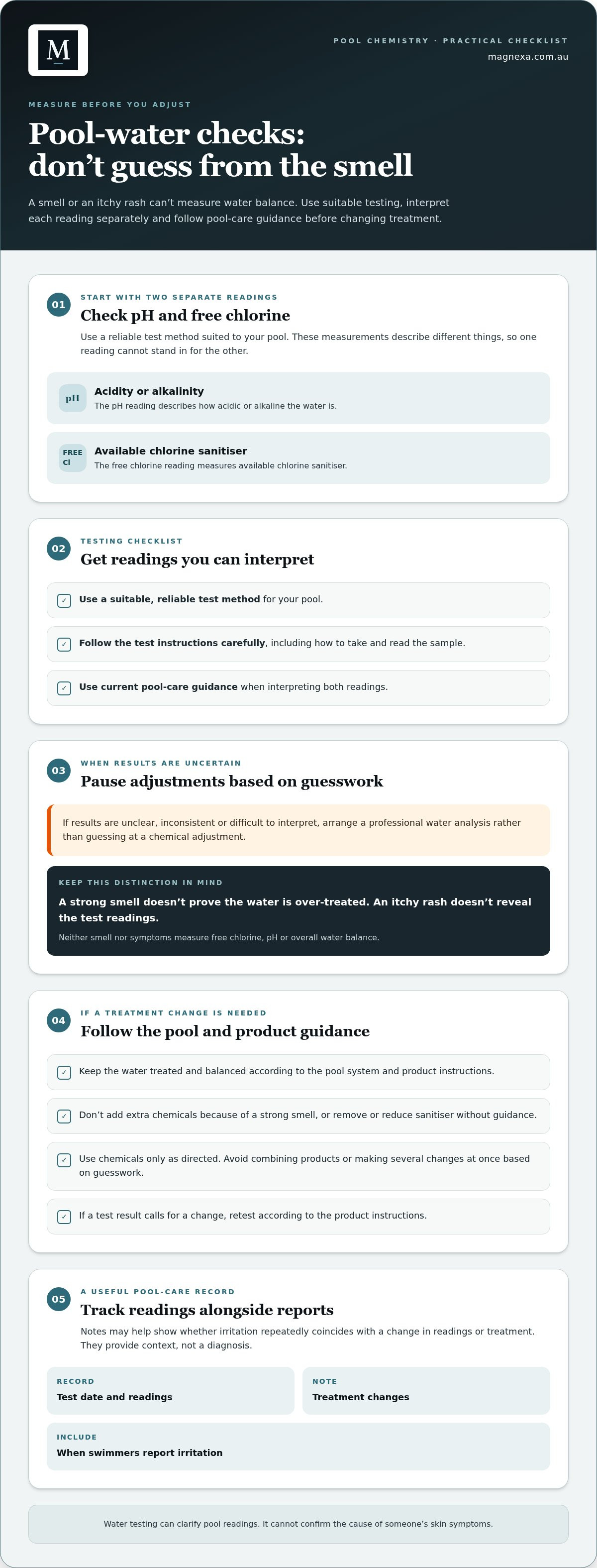
A smell or an itchy rash can’t measure pool-water balance; only suitable testing can show the readings. pH and free chlorine are separate measurements. pH describes how acidic or alkaline the water is, while free chlorine measures available chlorine sanitiser. One reading can’t stand in for the other, and both need to be interpreted using current pool-care guidance.
What should a pool owner check?
Start by checking pH and free chlorine with a reliable test method suited to your pool. Follow the test instructions carefully, including any guidance on taking and reading the sample. If results are unclear, inconsistent or difficult to interpret, arrange a professional water analysis rather than adjusting chemicals based on a guess. Testing gives you a clearer basis for action, but it won’t confirm the cause of someone’s skin symptoms.
A practical routine is to record the test date, readings, treatment changes and when swimmers report irritation. Over time, these notes may show whether symptoms repeatedly coincide with a change in readings or treatment. They’re useful context, not a diagnosis.
Does a strong chlorine smell prove the water is over-treated?
No. Smell isn’t a reliable measurement of free chlorine, pH or overall water balance. Don’t add extra chemicals because the pool smells strong, and don’t stop sanitising the water to avoid irritation. Test first, then follow the relevant pool-care and product guidance before making an adjustment.
If a test result calls for a change, use the chemical product only as directed and retest according to its instructions. Avoid combining products or making several changes at once based on guesswork. Keep records of readings and treatment changes alongside reports of itchy skin from pool water. That information can help you make a more informed next move.
If you’re exploring a mineral pool, treat it as a water-system choice, not a remedy for skin symptoms. Correctly calculating mineral quantities matters during a conversion. Magnexa’s magnesium pool minerals and dosing calculator are relevant to that decision, not to diagnosing or treating irritation.
Chlorine rash, dry skin or swimmer's itch: how to tell them apart
Itchy skin after swimming can have more than one explanation. Dryness, redness, stinging or bumps don’t identify a cause by themselves, and neither does how soon they appear. Use the setting and pattern as clues, not proof. This comparison can help you decide what to consider next, but it can’t replace assessment by a health professional.
| Possible cause | Exposure setting | Possible symptom pattern | Sensible next step |
|---|---|---|---|
| Irritation from treated pool water | After swimming in a sanitised pool | Itching, dryness, redness or stinging on skin that contacted the water | Rinse the skin and consider whether pool-water readings need checking. |
| Dry or sensitive skin, including eczema | Can occur after swimming or other water exposure | Dryness or itch; existing sensitive areas may feel more irritated | Use gentle skin care and seek advice if symptoms persist or worsen. |
| Swimmer’s itch | More associated with outdoor freshwater, though it can occur after other natural-water exposure | An itchy rash may develop after swimming; appearance and timing vary | Consider the exposure and seek medical advice if symptoms concern you. |
| Another skin cause | May occur with or without swimming | Symptoms vary and may coincide with pool use by chance | Get clinical advice if the cause is unclear or symptoms are concerning. |
What patterns may suggest irritation from treated pool water?
Dryness, redness, itching or a stinging feeling after contact with treated water may be consistent with irritation. Repeated exposure, sensitive skin or eczema-prone areas may affect how skin responds. These signs aren’t specific to pool irritation, however. A similar rash can have another cause, so don’t use symptoms alone to decide that chlorine is responsible.
When might another cause need consideration?
Swimmer’s itch is linked to parasites in outdoor water and is more associated with freshwater settings, such as lakes, than routine swimming in a treated pool. The type of water you swam in can be a useful clue, but it doesn’t confirm the cause. Rashes can also arise for reasons unrelated to swimming.
If symptoms persist, worsen, look infected or otherwise concern you, speak with a health professional. The phrase itchy skin from pool water describes when the discomfort occurs, not a diagnosis.
What to do when your skin itches after swimming
If itching starts in the pool, get out of the water. Rinse your skin with clean water as soon as practical, then gently pat it dry with a clean towel. Avoid scrubbing, which can add friction to already irritated skin.
What can I do straight after swimming?
Keep skin care simple while your skin is uncomfortable. Avoid fragranced products, harsh cleansers and anything that stings when applied. If a product seems to worsen the irritation, stop using it. Take a break from swimming if symptoms become uncomfortable or get worse in the water.
These steps may help remove pool water from your skin, but they won’t establish what caused the reaction. Keep personal care separate from pool adjustments. Don’t add chemicals, change the sanitiser level or stop sanitising based on a rash or a guess. If you own the pool, check its water readings and follow current pool-care and product guidance before making any changes.
When should I speak to a health professional?
Seek medical advice if symptoms are severe, persistent or worsening, or if the skin looks infected. Get advice if you’re concerned about the rash or if it affects a child. A health professional can assess the symptoms and advise on appropriate treatment. Don’t rely on the timing or appearance of itchy skin from pool water to diagnose the cause or decide which treatment to use.
If symptoms return after swimming, note when they occur, how they change and which water setting you used. If you manage the pool, record its test readings and any treatment changes separately. This information may help a clinician or support a more informed pool-water check, but it can’t replace either assessment.
Considering a mineral pool is a separate decision from treating skin irritation. Magnesium pool minerals are a pool-water option, not a proven treatment for itchy skin. Explore magnesium pool minerals if you’re considering a mineral-water setup.
Can mineral pool water help with itchy skin?
A mineral pool is a water-type choice, not a treatment for a skin condition. Magnesium pool minerals aren’t a proven way to treat or prevent itchy skin from pool water. Some swimmers may prefer how a particular pool feels, but personal comfort doesn’t show that the water will prevent irritation or suit everyone.
Mineral water also isn’t chemical-free or automatically hypoallergenic. Mineral pools still need appropriate sanitation and ongoing water testing. Some systems continue to use chlorine, so the pool’s treatment method and water balance remain important. Don’t reduce or stop sanitising to see whether skin symptoms improve.
What changes when a pool uses magnesium minerals?
Adding magnesium minerals changes the pool-water setup, but it doesn’t remove the need to test and maintain the water. Follow the instructions for the specific pool system and calculate quantities for the pool’s measured needs. Avoid estimating doses or making changes based on skin symptoms. For background, read Magnesium Pool Salt: A Straightforward Guide for Pool Owners.
Water feel is personal. A pool that feels more comfortable to one swimmer may not feel the same to another, and that experience isn’t evidence of a medical benefit.
How to consider a mineral pool without expecting a cure
Assess three things separately: whether the pool is being maintained and tested appropriately, whether a mineral setup suits your pool, and how your skin responds. If irritation continues, seek medical advice rather than treating a water conversion as a remedy. A clinician can assess symptoms that pool-water testing can’t explain.
If you’re considering a conversion, Mineral Pool Conversion: Step-by-Step Guide is a useful next read. Magnexa’s dosing calculator can help estimate the mineral quantity for your pool. Magnexa delivers pool minerals across South East Queensland, including Brisbane, Moreton Bay, the Sunshine Coast, Ipswich, Logan and Redlands, and the Gold Coast.
Take a measured next step
Itchy skin from pool water can have several causes, and the timing or appearance of a rash can’t confirm which one is responsible. Rinse with clean water, dry gently and avoid harsh or fragranced products while your skin is irritated. If symptoms are severe, persistent, worsening or concerning, seek advice from a health professional.
For pool owners, testing pH and free chlorine provides a better basis for checking water balance than relying on smell or skin symptoms. Keep sanitising the water, and follow pool-care and product guidance before making chemical changes. A mineral pool is another water-system option, not a proven treatment for itchy skin or a medical condition.
If you’re considering mineral water, Magnexa supplies pool minerals in 10 kg and 25 kg bags, as well as starter packs. Use the dosing calculator to estimate quantities for your pool. Delivery is available across South East Queensland, including Brisbane, Moreton Bay, the Sunshine Coast, Ipswich, Logan and Redlands, and the Gold Coast. Explore magnesium pool minerals and the dosing calculator as you weigh up your options.
Frequently Asked Questions
Can chlorine in pool water make your skin itchy?
Yes, chlorine can irritate or dry the skin, which may lead to itching, redness or stinging. This is generally irritation rather than a true chlorine allergy. The chance of irritation may depend on the water’s balance and your skin’s sensitivity. These symptoms don’t prove chlorine is responsible, though. Dry skin, eczema and other causes can feel similar, so consider the pool setting and seek medical advice if symptoms persist or concern you.
How do you stop your skin itching after swimming?
Leave the water if the itching is uncomfortable or getting worse. Rinse your skin with clean water, then gently pat it dry with a clean towel. Avoid scrubbing and skip fragranced or harsh products while your skin is irritated. These steps may help remove pool water from your skin, but they won’t identify the cause. If symptoms are severe, persistent or worsening, speak with a health professional.
Is a pool rash the same as swimmer's itch?
No. A rash after swimming in a treated pool may be irritation from water or another cause. Swimmer’s itch is linked to microscopic parasites in outdoor water, particularly freshwater, and can also occur after some saltwater exposure. It’s less associated with routine swimming in a treated pool. Itching and redness can overlap between conditions, so the rash’s appearance or timing can’t confirm which cause applies.
Can a mineral pool cause itchy skin?
It’s possible to experience irritation after swimming in any pool, including a mineral pool. Mineral water isn’t chemical-free or automatically hypoallergenic, and mineral pools still require appropriate sanitation and regular water testing. Magnesium pool minerals aren’t a proven treatment for itchy skin or a medical condition. If you’re exploring a mineral pool in Brisbane, Moreton Bay, the Sunshine Coast, Ipswich, Logan and Redlands, or the Gold Coast, treat it as a water-system choice, not a skin remedy.
Does showering after swimming help with itchy skin?
Rinsing with clean water after swimming can wash pool water from your skin and is a sensible first step if you feel itchy. Pat dry gently rather than rubbing, and avoid fragranced or harsh products on irritated skin. A shower may help remove residue, but it can’t establish what caused the symptoms or guarantee they’ll stop. If the rash persists or worsens, seek advice from a health professional.
When should I see a doctor about a rash after swimming?
Speak with a health professional if the rash is severe, persistent, worsening, looks infected or otherwise concerns you. Seek advice if it affects a child or causes significant concern. A clinician can assess the symptoms and advise on suitable care. Don’t rely on when the rash appeared or how it looks to diagnose the cause. Pool-water testing can help assess the water, but it can’t diagnose a skin condition.
Can eczema make your skin more sensitive to pool water?
Yes, skin affected by eczema may be more sensitive or prone to irritation, and swimming can leave it feeling dry or uncomfortable. That doesn’t mean pool water is definitely the cause of a flare. Rinse with clean water after swimming, pat the skin dry and avoid harsh or fragranced products if it’s irritated. If symptoms persist or worsen, ask a health professional for advice on managing your skin.
Frequently Asked Questions
More articles