Mineral Pool Conversion: Step-by-Step Guide
30 September 2026 · 15 min read
A mineral pool conversion doesn’t start with a bag of minerals. It starts with checking what your existing equipment and water can support. Before adding minerals, confirm your pool volume, check equipment and product compatibility, and test the current water balance. Guessing at any of these can leave you unsure whether the dose or sequence is right.
If you’re uncertain about compatibility, how much mineral product to use, or whether the change will affect sanitisation, check the directions for your pool and chosen product before proceeding. Mineral systems and product directions differ, so general advice shouldn’t replace those instructions. This guide explains what to check before starting, how to plan the conversion in a clear order, and how to estimate the quantity from your pool volume while maintaining sound water care.
You’ll also see how a dosing calculator and starter packs can help with planning, plus what to consider when sourcing supplies in South East Queensland. The aim is a mineral pool conversion you can work through step by step, with a clear distinction between general guidance and instructions specific to your pool and product.
Key Takeaways
- A mineral pool conversion adjusts the water; your existing filtration and sanitation equipment may remain part of the setup.
- Your current sanitation system affects which product directions and compatibility checks apply.
- Use a clear sequence: confirm, test, calculate, add, circulate and retest, following the product label and equipment instructions.
- After conversion, keep up regular water testing, filtration and sanitation. Mineral top-ups depend on test results, pool use and product directions.
- Pool-volume-based dosing helps estimate your mineral supply needs before choosing an appropriate option.
What mineral pool conversion changes in your existing pool
A mineral pool conversion changes the water by adding a suitable mineral product at the amount specified for that product and pool. It doesn’t automatically mean rebuilding the pool or replacing the pump, filter or sanitation equipment. Those parts may remain in use, provided they’re compatible with the chosen product and its directions.
Minerals don’t remove the need to sanitise pool water. The sanitation method depends on the existing setup and the mineral system you choose. Check the product label and equipment instructions before making changes. Treat general conversion advice as a starting point, not a substitute for directions written for your particular system.
What makes a pool a mineral pool
Mineral products add dissolved minerals to the water. Their composition and target level vary between systems, so there isn’t one formula or set of operating settings that applies to every mineral pool. Follow the specific product directions rather than using another system’s dose or target as a guide.
A mineral product also isn’t necessarily the sanitiser. If your pool uses a saltwater chlorinator, the unit produces chlorine through electrolysis. This is distinct from simply adding minerals; see how salt water chlorination works for an explanation of the process. Don’t assume a mineral addition replaces the sanitation method your pool requires.
What stays the same after conversion
Filtration and circulation still move water through the system, and regular testing helps you monitor its condition. Continue the sanitation routine required by your pool and product. Conversion changes the water, not the need for ongoing care.
Before adding anything, check compatibility with your filter, pump and sanitation equipment. Then use the product label and equipment instructions to guide operation and testing. For a closer look at magnesium products and their role in pool water, read this magnesium pool salt guide.
A conversion is different from a routine mineral top-up. A conversion is the planned initial adjustment to the pool water; a top-up is a later addition made when testing and product directions indicate it’s needed. Neither means the pool itself has been rebuilt or its equipment replaced. Keeping these tasks separate helps you plan the change without assuming one dose, or one type of mineral product, suits every pool.
Check pool water, equipment, and volume before mineral pool conversion
Get the starting details right before choosing a dose. Pool volume helps determine how much product may be needed, while current water readings and equipment help establish whether the product suits your setup. A guess can lead to an unsuitable dose or an avoidable compatibility issue.
How to establish pool volume and current water conditions
Use a reliable pool record or a calculator that accounts for the pool’s shape, length, width and depth. A rectangular pool is easier to estimate than one with a curved edge, sloping floor or separate sections. If you don’t know the average depth or have changed the pool, check the measurements before relying on an old volume figure.
Test the water before adding treatment and write down the results. Record relevant readings such as pH, alkalinity and sanitiser level, along with the date and any recent additions. This gives you a baseline to compare with later tests. The San Francisco Department of Public Health’s guide to pool water chemistry explains these measures; use your product and equipment instructions for pool-specific targets.
How to check equipment and product compatibility
Read the mineral product guidance alongside the manufacturer’s instructions for your pool, chlorinator, pump and filter. Check the pool surface too. Don’t assume a chlorinator or surface is compatible with every mineral formulation, or that settings for one system apply to another.
If the guidance is unclear or documents conflict, pause before adding minerals. Ask a qualified pool professional to assess compatibility rather than relying on a general recommendation. Keep the product label available so any advice relates to the exact product you intend to use.
Before a mineral pool conversion, confirm four things: pool volume, current water balance, equipment compatibility and the product instructions. This checklist helps you identify missing information before it affects your dose or conversion plan.
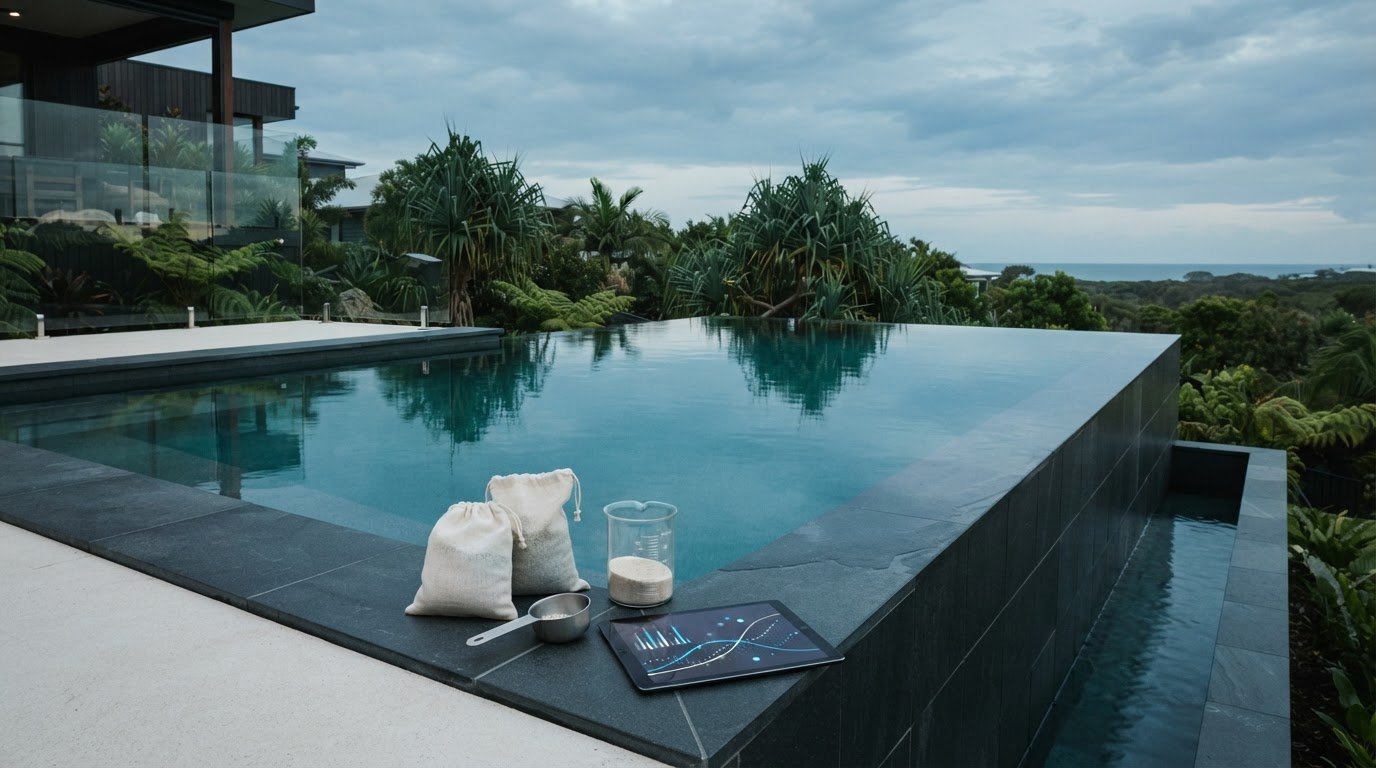
Once you have a dependable volume, Magnexa’s pool mineral dosing calculator can help estimate the quantity to consider. Treat the result as a planning aid, then verify it against the directions for your chosen product before dosing.
Choose a conversion approach without assuming every pool is the same
The right preparation depends on how your pool is sanitised now. A saltwater pool usually has a salt chlorinator that generates chlorine from dissolved salt. A chlorine-treated pool may rely on manually added chlorine or another system. These setups don’t start from the same water conditions, so identify the existing treatment method and equipment before choosing a mineral product.
For either pool type, use the product instructions and equipment guidance to plan the change. Don’t assume that adding minerals means you can switch off or remove the existing sanitiser. The mineral product may suit one setup but not another, and its directions determine the required checks and process.
Converting an existing saltwater pool
Start by checking the current salt level and any mineral readings relevant to the product you’re considering. Then confirm that the product suits your chlorinator and follow the chlorinator manufacturer’s instructions. Existing salt levels may affect how you plan the addition, so don’t calculate a dose as if the pool water were untreated.
There’s no universal drain-or-no-drain answer. Whether water needs to be removed depends on the actual readings, product directions and pool setup. Don’t drain or dilute the pool based on generic advice. If the instructions don’t resolve the question, ask a qualified pool professional to assess your specific pool.
Converting a chlorine-treated pool
First identify how chlorine is being added and test the water before making a change. A pool dosed manually may require different equipment checks from one using a chlorinator. Confirm that the mineral product is suitable for the existing sanitation system, then follow the product label and equipment manufacturer’s guidance.
Don’t assume the conversion requires replacing the current system, or that the mineral product can take over its sanitation role. If compatibility or the correct sequence is unclear, pause and seek pool-specific advice before adding anything. Check the chosen product’s directions for a conversion process that fits your pool.
In both cases, the key difference is the starting point: saltwater pools need their existing salt and chlorinator considered, while chlorine-treated pools need their current dosing method and equipment identified. These checks help you follow directions that fit your setup rather than applying another pool’s process.
Plan a mineral pool conversion around measured conditions, not a blanket instruction to drain, retain all the water or change equipment. Use the product guidance first. If it doesn’t address your readings or sanitation system, get advice specific to your pool before proceeding.
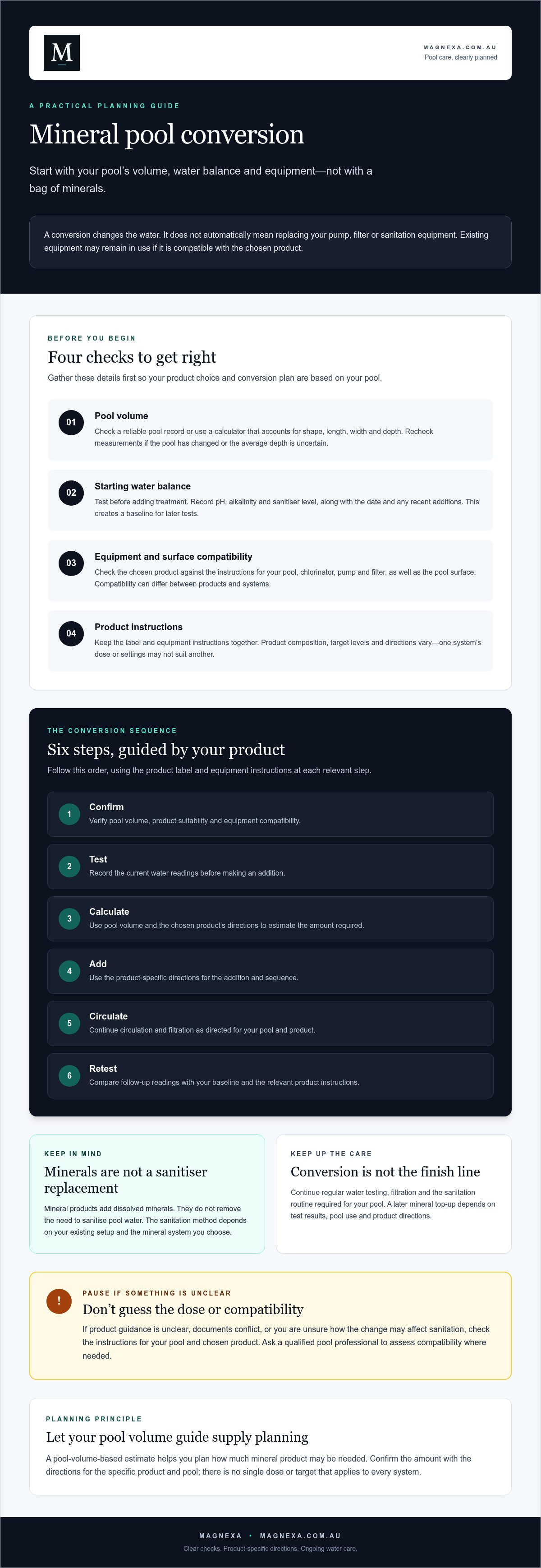
How to convert your pool to mineral water step-by-step
Follow a measured sequence for a mineral pool conversion. Product directions take priority over general advice because products can differ in composition, target levels and application instructions. Don’t add minerals until you’ve confirmed the pool volume, checked the current water and verified that the product suits your setup.
- Confirm: Check your pool volume and identify the existing sanitation equipment. Read the mineral product label and equipment instructions for compatibility and any preparation requirements.
- Test: Record the current water readings before making changes. These results provide a baseline and may affect how you plan the dose.
- Calculate: Use the confirmed pool volume and the product-specific target and directions to estimate the amount needed.
- Add: Follow the label’s instructions for adding the product. Don’t estimate by eye or borrow a dose from another mineral system.
- Circulate: Run the pool equipment as directed so the product can mix through the water.
- Retest: Test again at the point and in the way specified by the product and equipment guidance. Make an adjustment only when the results and instructions support it.
Calculate the mineral quantity before adding product
The required quantity depends on pool volume, current conditions and the chosen product’s directions. A pool already containing salt or minerals may need a different calculation from one starting at a different level. Don’t use a universal dosage: without a verified product specification, a general figure could give you the wrong starting amount.
Measured pool volume and the product label determine the starting dose. Use Magnexa’s pool mineral dosing calculator to help plan the quantity from your pool details, then compare the estimate with the instructions for your specific product before dosing.
Add minerals and check the water again
Apply the product only as directed. Follow its instructions for where and how to add it, along with any guidance about circulation and testing. Don’t combine products or change equipment settings unless the relevant directions say to do so.
After circulation, retest according to the product and equipment guidance. If a reading is outside the stated target, use the applicable instructions to decide what to do next. Avoid adding more simply because the water looks unchanged; test results, not appearance or guesswork, should guide adjustments.
For pool owners in South East Queensland, Magnexa’s calculator is a practical way to plan a product quantity before sourcing minerals. Use the estimate as a planning step, not a replacement for the product label or equipment instructions.
Maintain the converted pool and plan your mineral supply
Conversion is the start of the new water routine, not the end of pool care. Keep filtration, circulation and sanitation running as directed for your equipment and mineral product. Continue testing the water at the intervals and for the measures specified in those instructions. A mineral pool still needs appropriate sanitation and balanced water.
What to monitor after mineral pool conversion
Use your product guidance to check sanitiser, mineral levels and water balance. Keep a simple log of test results, dates and products added. That record helps you see whether readings are stable and gives useful context if a result changes.
There isn’t a fixed top-up schedule that suits every pool. The need for more minerals depends on test results, pool use and the product directions. Don’t add more solely because a set period has passed or the water looks different. If a change persists, review the readings and seek advice from a qualified pool professional before making further adjustments.
Where to source minerals in South East Queensland
Work out the quantity from your confirmed pool volume and the instructions for the selected product. Magnexa’s dosing calculator can help estimate a quantity from your pool details, while starter packs are another option to consider for a conversion. Treat either as a planning aid, then check the product directions to confirm what suits your pool.
Magnexa supplies magnesium pool minerals in 10 kg and 25 kg bags, as well as starter packs. Delivery is limited to South East Queensland, covering Brisbane, Moreton Bay, the Sunshine Coast, Ipswich, Logan, Redlands and the Gold Coast. Check that your location is within this area before planning supply.
Before ordering, have your pool volume and chosen product information to hand. That makes it easier to compare the estimated quantity with the label and avoid buying on a guess. For details on the available mineral products and supply options, visit Magnexa’s website.
Plan your conversion with measured steps
A successful mineral pool conversion starts with the details of your pool, not a generic dose. Confirm the volume, test the water and check that your equipment is compatible with the chosen product. Then follow the label through adding, circulating and retesting. Your existing sanitation and filtration routines still matter after conversion.
For supply planning, Magnexa offers a pool mineral dosing calculator, minerals in 10 kg and 25 kg bags, and conversion starter packs. Delivery is available across South East Queensland, including Brisbane, Moreton Bay, the Sunshine Coast, Ipswich, Logan, Redlands and the Gold Coast.
Use your pool details to estimate the quantity before ordering, then check the result against the product instructions. Use Magnexa’s pool mineral dosing calculator to start planning. With accurate measurements and product-specific directions, you can make the change one careful step at a time.
Frequently Asked Questions
Can I convert a saltwater pool to a mineral pool without draining it?
Sometimes, but whether the water can stay depends on its current salt and mineral levels, your equipment and the product instructions. Test the water first, then check the product’s compatibility guidance against your chlorinator and pool surfaces. Don’t assume a drain is always needed, or that every pool can retain all its water. If the readings or instructions leave you unsure, get advice from a qualified pool professional before adding minerals.
Do mineral pools still need chlorine?
Many mineral pool systems still require a sanitiser, including chlorine, to control contaminants. Adding minerals alone doesn’t sanitise the water or remove the need for routine testing. The required setup depends on the mineral product and your pool equipment. Follow the product directions and chlorinator guidance, and use regular water tests to check sanitiser levels. Don’t switch off or change an existing sanitation system unless its instructions and the product guidance support that change.
How much mineral salt do I need to convert my pool?
The quantity depends on your confirmed pool volume, current water conditions and the product’s specified target. Check pool measurements or records before calculating, then follow the product label rather than estimating from pool size alone. Magnexa’s dosing calculator can help you plan a quantity from your pool details. For pool owners in Brisbane, Moreton Bay, the Sunshine Coast, Ipswich, Logan, Redlands and the Gold Coast, Magnexa’s delivery is limited to South East Queensland.
Can I use magnesium minerals with my existing saltwater chlorinator?
It depends on the mineral formulation and the chlorinator model. Check the product directions and equipment manufacturer’s guidance for compatibility, including any instructions about salt or mineral levels. The phrase “mineral pool” doesn’t confirm that every product works with every chlorinator. If the manuals don’t answer your question, contact the equipment maker or ask a qualified pool professional before changing the water or adjusting the system.
Do I need to change my pool filter for mineral pool conversion?
No, a mineral pool conversion doesn’t automatically mean you need a new filter. Whether your current filter is suitable depends on its type and condition, the mineral product and your pool system’s instructions. Check the equipment guidance before making changes, and keep filtration running as directed during and after conversion. If circulation or water clarity is poor, check the water and equipment first. Don’t replace a filter without evidence that it’s unsuitable or faulty.
How long does mineral pool conversion take?
There’s no single timeframe that applies to every pool. Preparation, water testing, accurate volume checks, equipment compatibility and product directions all affect the process. Circulation and retesting also take time, and the instructions for your chosen product should determine when to do them. Allow time to confirm the setup before adding minerals. Don’t assume the pool is ready to use immediately; follow the product guidance for circulation and any checks before swimming.
Can I convert my pool to minerals myself?
Some pool owners may be able to manage a straightforward conversion by following the mineral product and equipment instructions. You’ll need a reliable pool volume, current water test results, compatible equipment and a plan to maintain sanitation. If readings are unusual, equipment guidance is unclear or water problems persist, pause and seek advice from a qualified pool professional. Don’t rely on a generic dose or assume one conversion process suits every pool.
Frequently Asked Questions
More articles