How Much Magnesium to Add to Your Pool? Dosage Guide
9 October 2026 · 15 min read
There isn’t one standard answer to “how much magnesium to add to pool” water. The amount depends on your pool’s water volume, the minerals already present and the dose rate for the product you’re using. A bag count based on a rough volume estimate can leave the mineral level off target.
Start with the best pool-volume estimate available, then use the product’s stated rate and target. Rates can differ between products, so don’t assume that a dose for one mineral system will suit another.
This guide explains what to check before dosing, how to calculate a quantity from your pool volume and the relevant product rate, and how to measure and apply it. Magnexa’s dosing calculator can help you work out a quantity for your pool. Reassess the water after adding minerals rather than assuming the first dose is final.
Key Takeaways
- Calculate how much magnesium to add using your pool’s volume and the rate stated for your mineral product.
- Convert the pool volume to the units used in the product directions before multiplying by the dose rate.
- Distinguish an initial dose, a pool conversion and a later top-up. The starting mineral level affects the quantity needed.
- Measure the calculated amount and follow the product’s directions for preparation and application.
- Use Magnexa’s dosing calculator to help work out a quantity for your pool.
How much magnesium should you add to a pool? Start with the right inputs
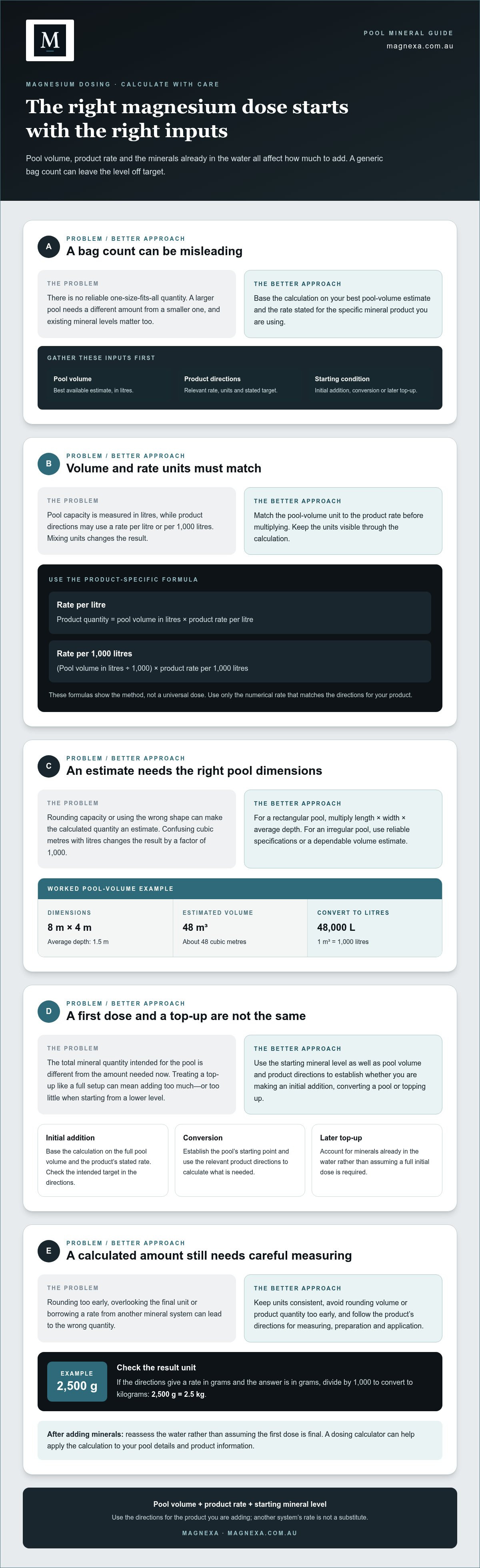
Base the dose on your pool’s water volume and the mineral product’s stated rate. There’s no reliable bag count for every pool: a larger pool requires a different quantity from a smaller one, and the amount also depends on the minerals already in the water and whether you’re setting up the system or topping it up.
The product rate and pool volume determine the dose because the rate states how much product to use for a defined amount of water. Follow the directions for the product you’re adding. A rate or bag count from another mineral system is not a substitute.
Separate the pool’s total mineral quantity from the amount being added now. The first refers to the minerals in the water and the level intended for that product. The second is the amount needed to move towards that level. Confusing the two can lead to calculating a full setup when you only need a top-up, or adding too little when starting from a lower mineral level.
Why pool volume changes the magnesium quantity
At the same product rate, a larger volume of water needs more product than a smaller volume. Pool capacity is measured in litres, while the mineral product is measured by mass or volume as specified in its directions. These are different units. Magnesium is a chemical element, but pool minerals are products with their own application instructions. For background on the element, see Magnesium (element).
Use the most accurate pool-volume figure available. If you round the capacity or estimate the dimensions, the calculated quantity will also be an estimate. Differences in assumed volume can change the dose, especially for a large pool. Keep the units consistent with the product rate.
What to know before calculating a dose
Gather the inputs before calculating. Check the product directions for the relevant rate, units and any stated target. Then establish the pool’s starting point: are you preparing a pool, converting an existing one or replacing minerals lost since the last addition? The starting mineral level affects how much more is needed.
- Pool volume: your best available estimate of capacity in litres.
- Product directions: the rate, units and product-specific target that apply to the mineral product.
- Starting condition: whether this is an initial dose, a conversion or a later top-up, based on current water information.
Don’t use a target from another product or assume a mineral composition that the directions don’t state. With these inputs clear, you can calculate a quantity for your pool instead of relying on a generic bag count.
How to calculate magnesium for a pool using the product rate
Once you have a pool-volume estimate, apply the rate in the directions for your specific mineral product. Keep the units intact. If the rate is given per litre, multiply the pool volume in litres by that rate. If it’s given per 1,000 litres, divide the pool volume by 1,000 first, then multiply by the stated amount.
Formula: product quantity = pool volume in litres × product rate per litre. For a rate stated per 1,000 litres, use: (pool volume in litres ÷ 1,000) × product rate per 1,000 litres. These formulas show the method, not a universal dose. Use a numerical rate only when it matches the directions for the product you’re adding.
Measure pool volume before using the formula
For a rectangular pool, multiply its length by its width and average depth. For example, an 8 m by 4 m pool with an average depth of 1.5 m holds about 48 cubic metres. One cubic metre equals 1,000 litres, so 48 cubic metres is an estimated 48,000 litres. Use the average depth, particularly if the pool floor slopes.
This method won’t suit every shape. For an irregular pool, use reliable pool specifications or a dependable volume estimate rather than forcing its dimensions into a rectangle formula. Note whether the figure is in cubic metres or litres before calculating. Confusing the two changes the result by a factor of 1,000.
Apply the rate and check the units
Match the product rate’s volume unit to your pool figure, then check the unit of the result. If the directions give a rate in grams and your answer is in grams, divide by 1,000 to convert to kilograms. For example, 2,500 g is 2.5 kg. Avoid rounding the volume or product quantity too early, and follow the directions for measuring the final amount.
A worked dose example is useful only when the product rate, units and applicable target are known. A rate from another mineral system isn’t a safe substitute. The magnesium pool dosing calculator can help apply the calculation to your pool details and product directions.
Health information about magnesium, such as Harvard Health Publishing’s Health benefits of magnesium, concerns magnesium’s role in human health. It isn’t a guide to pool-water concentration or product dosage. Use pool-specific directions to calculate a pool dose.
For a pool-specific quantity, use Magnexa’s pool mineral dosing calculator with your pool volume and relevant product information. It gives you a practical starting point before you measure and apply minerals according to the product instructions.
Initial dose or top-up? Why magnesium quantities differ
The quantity depends on whether you’re adding minerals for the first time or adjusting water that already contains them. To work out how much magnesium to add to pool water, use the starting mineral level as well as the pool volume and product directions. A full initial addition and a top-up are different calculations.
Use this comparison to identify the right starting point before calculating:
| Situation | What to base the calculation on | Key check |
|---|---|---|
| Initial addition | Full pool volume and the product’s stated rate | Use the directions for the product’s intended target. |
| Conversion | Full pool volume and the starting water condition | Don’t assume an existing salt pool has the same mineral level as another pool. |
| Later top-up | Current test results and the applicable product directions | Calculate only the adjustment indicated by the water information. |
Calculating an initial mineral addition
An initial addition applies when setting up the pool’s mineral system or bringing the water to the target specified for the product. Use the full pool volume and verified product rate as the calculation inputs. This is a starting dose, not a default bag count for every pool.
When converting an existing pool, don’t infer its current mineral level from the fact that it already uses salt. Pools can start at different levels. Use relevant water information and the product directions to work out what needs to be added, rather than treating the pool as though it contains no minerals.
Working out a later top-up
A top-up responds to measured water conditions, not the initial quantity. Use test results to understand the current mineral level, then follow the product directions to calculate any adjustment. If the water is already close to the specified target, adding the full initial amount again could take it beyond that target. See the pool mineral balance guide for wider checks.
For example, a pool that has lost some minerals since setup may need a partial adjustment. The quantity depends on the test result and the product’s stated rate. Don’t estimate a top-up by counting bags used previously. That records the earlier addition, not the pool’s current condition.
Before dosing, make sure the test result and product directions use compatible units and refer to the same applicable target. For more context on mineral products in pool treatment, see the pool mineral treatment guide. Calculate the new addition from the pool’s current starting point.
How to add magnesium minerals after calculating the pool dose
A correct calculation is useful only if you measure and apply the amount as directed. Before opening a bag, confirm that the pool-volume figure, product rate and type of addition suit your situation. If you’re unsure how much magnesium to add to pool water, resolve uncertainty about the volume or starting level before dosing.
- Confirm the pool volume. Use your best available capacity figure in the units required by the product directions.
- Verify the product rate. Check the exact directions for the mineral product, including preparation and application instructions.
- Calculate the amount. Use the rate for an initial addition or top-up that matches the current water information.
- Measure the dose. Weigh the calculated quantity rather than estimating by eye or guessing a fraction of a bag.
- Apply it as directed. Follow the product instructions for adding the minerals and operating pool equipment.
- Reassess the water. Allow circulation and wait before retesting only as specified by the product directions.
Never add more product to compensate for an uncertain pool-volume estimate. Extra minerals won’t make an uncertain calculation more accurate. Refine the volume estimate, then recalculate the quantity.
Measure the mineral quantity accurately
Use suitable scales to weigh the calculated dose. A partial bag is difficult to estimate by sight, and bag size is not a substitute for a measured quantity. If you don’t need the whole bag, keep the remainder dry and store it according to its label. Keep the measured minerals separate from other water-treatment products. Follow each product’s directions rather than mixing treatments together.
Reassess the water after adding minerals
Circulation requirements and the right time to retest depend on the product instructions, so don’t assume a fixed waiting period. When the directions say the water is ready to check, test it using an appropriate method and compare the result with the product’s guidance. If the reading doesn’t match the intended range, reassess before adding more.
Mineral dosing is one part of pool water care. Record the amount added and the test information so future adjustments reflect the pool’s condition, not just your memory. For wider water-balance checks, refer to the pool mineral balance guide, but continue to follow product-specific dosing directions.
For a measured dose based on your pool details, use Magnexa’s dosing calculator before adding minerals.
Use Magnexa’s calculator to work out your pool’s magnesium quantity
A pool-specific estimate needs more than a guessed bag count. Gather your pool volume, current water information and the directions for the magnesium mineral product you plan to use. These details help distinguish an initial addition from an adjustment to an existing mineral level.
Use Magnexa’s dosing calculator to apply those details to your pool. It helps you work towards a quantity suited to your pool’s circumstances instead of relying on a general figure that may not match your volume or starting water. Keep the product directions handy so the rate and units match the minerals you’re adding.
Turn the calculated quantity into a practical order
Once you have a calculated requirement, compare it with Magnexa’s 10 kg and 25 kg pool mineral bags. Use the calculated quantity to plan your order. Don’t choose a bag count based only on an assumed pool size or what another pool owner used. Bag size is a supply format, not a dosing recommendation.
If your calculated amount doesn’t match a whole bag, account for the difference when planning your purchase and measure the dose you actually add. Follow the product label when storing any remainder. Starter packs are also available for pool owners beginning with minerals.
Magnexa delivers pool minerals across South East Queensland, including Brisbane, Moreton Bay, the Sunshine Coast, Ipswich, Logan and Redlands, and the Gold Coast. Work out the quantity from your pool and product directions first, then choose the bag format that suits your requirement.
Next steps for a pool-specific mineral dose
Keep the process straightforward: establish the pool volume, apply the relevant product rate, calculate the quantity, then prepare and add the minerals according to the product directions. If your volume or starting water information is uncertain, refine those details before dosing. A result based on sound inputs is more useful than a precise-looking figure built on a guess.
Use the Magnexa dosing calculator to work out a quantity for your pool. It provides a practical starting point for deciding how much magnesium to add to pool water, with the calculation tied to your pool details and relevant product directions.
When you’re ready to compare mineral supply options, view Magnexa pool minerals for local supply information.
Set your next dose from a clear baseline
A measured addition gives you a useful reference for future pool checks. Record the amount added and the water information used. Your next adjustment can then respond to the pool’s current condition rather than rely on memory or repeat an earlier dose.
If you’re still deciding how much magnesium to add to pool water, use the best volume and test information available. A pool-specific calculation gives you a grounded starting point. Follow the mineral product’s directions when preparing, adding and reassessing the water.
Use the Magnexa dosing calculator to work out your pool’s mineral quantity. Check the inputs carefully, then proceed with a dose that fits your pool.
Frequently Asked Questions
How much magnesium should I add to my pool per 1,000 litres?
There’s no single dose per 1,000 litres that applies to every magnesium product. Use the rate and units in the directions for your product to calculate how much magnesium to add to pool water. If the rate is stated per 1,000 litres, divide your pool volume by 1,000, then multiply by that rate. Don’t substitute a figure from another product.
Can I calculate a magnesium dose if I do not know my pool’s exact volume?
Yes, but treat the result as an estimate until you can refine the volume figure. Check pool plans, specifications or records first. If those aren’t available, estimate from the pool’s shape and dimensions, using average depth rather than only the deepest point. A rough estimate for an irregular pool can create a substantial dosing error. Don’t add extra minerals to compensate for uncertainty.
What happens if I add too much magnesium to my pool?
Too much can take the water beyond the mineral level intended by the product and disrupt the planned balance. Don’t respond by adding other treatment products at random. Check the product directions and test the water using a method suited to the mineral system. Record how much you added and when, then use the test result and product guidance to decide whether an adjustment is appropriate.
Should I add magnesium minerals with the pool pump running?
Follow the product label for pump and circulation instructions. Products can differ in how they’re prepared and added, so don’t assume one method applies to every mineral. Check whether the directions require the pump to be operating or specify a particular point of application. If they include a circulation step afterwards, follow it as written rather than choosing an arbitrary run time.
Can I add magnesium minerals to an existing saltwater pool?
It may be possible, but an existing saltwater setup doesn’t tell you the pool’s current magnesium level or how much to add. Check the mineral product’s directions for use with your pool system, then use relevant water-test information to establish the starting condition. Don’t treat a salt pool as though it contains no minerals. The required quantity depends on the product and the water’s current condition.
How soon can I swim after adding magnesium minerals?
Use the product label to determine when swimming is appropriate. There isn’t one wait time that applies to every mineral product and application method. If the directions require circulation, preparation or a water check before swimming, complete those steps first. Don’t rely on clear-looking water as the only indication that it’s ready. Follow the product’s specific guidance.
Do I need to add magnesium again after backwashing or topping up the pool?
Not automatically. Backwashing and refilling can remove or dilute some pool water, but the amount of magnesium lost depends on how much water was discharged and replaced. Test the water and follow the product directions before deciding whether to add more. A small top-up may not require another mineral dose. Don’t repeat the initial addition unless the current readings and product guidance indicate it’s needed.
Frequently Asked Questions
More articles