Pool Mineral Treatment: What It Does and How to Use It
6 October 2026 · 14 min read
Pool mineral treatment changes the mineral content of your water, but minerals don’t sanitise a pool on their own or replace routine water testing. Understanding that distinction helps you choose a suitable treatment amount without overlooking sanitiser or water balance.
If you’re wondering whether minerals do the same job as chlorine, or how mineral levels affect the rest of your pool chemistry, start by identifying your pool system. This guide explains what minerals do, how they fit alongside sanitising and water balance, and what to check before adding a treatment.
The amount you need depends on your pool’s volume, the water’s starting point and the product instructions. Check those details before adding minerals, use a dosing calculator to estimate the quantity, and confirm the product is suitable for your pool system.
Key Takeaways
- A pool mineral treatment changes the water’s mineral content. Its role depends on the pool system and product instructions.
- Minerals, sanitiser and water-balance adjustments do different jobs, so keep testing and follow your system’s guidance.
- Before adding minerals, identify your pool system, confirm its volume and test the water.
- Use the product label and pool-system instructions to calculate the amount and apply it correctly.
- Magnexa’s dosing calculator can help estimate quantities by pool volume. Magnesium pool minerals are available in 10 kg and 25 kg bags, with delivery across South East Queensland.
What Is Pool Mineral Treatment, and What Does It Change?
Pool mineral treatment adds minerals to the water according to the pool system and product instructions. It changes the water’s mineral content, but doesn’t sanitise the pool or balance every part of its chemistry by itself.
“Mineral pool” can describe different setups. Some use mineral salts with compatible equipment, while others add minerals as one part of an existing pool-care routine. The right approach depends on your equipment and the product’s intended use, not simply on the word “mineral” on a bag.
What pool mineral treatment means in practice
Mineral treatment is one part of managing pool water. Minerals dissolve and change its composition. This is different from mineral material in a pool’s surface finish, which forms part of the pool structure rather than treating the water.
Pool owners may choose a mineral system because of how they prefer the water to feel or because they want a different pool-water approach. These preferences aren’t a promise of a health or skin benefit. Check the product contents, how it is intended to work with your equipment, and the manufacturer’s directions.
Some systems use minerals alongside a chlorinator that produces chlorine for sanitation. Other approaches use mineral-based sanitising components differently. The pool sanitation methods overview describes several approaches, including mineral sanitizers. The practical step is to establish what your specific system does, rather than assume every mineral treatment works in the same way.
What mineral treatment does not do
Minerals alone shouldn’t be treated as a substitute for suitable sanitising. Adding minerals doesn’t automatically kill contaminants, prevent algae or make water safe to swim in. If your pool system relies on a sanitiser, keep using it as directed.
Mineral treatment also doesn’t remove the need to test and adjust pool water. Monitor the relevant water-balance readings and sanitiser level, then make corrections in line with your pool-system guidance. Clear water alone doesn’t prove that it is properly balanced or sanitised.
In short, mineral treatment changes mineral content, sanitising controls unwanted microorganisms, and water balancing keeps chemical conditions within the appropriate range. These jobs can affect one another, but they aren’t interchangeable. Before adding minerals, identify your pool system and follow the product label and equipment guidance. That gives you a sound basis for calculating the treatment amount and maintaining the rest of your pool care.
How Pool Minerals Work Alongside Sanitiser and Water Balance
Pool care involves separate checks and adjustments. Minerals change the water’s mineral content. A sanitiser controls harmful microorganisms. Water-balance measures, including pH and total alkalinity, help keep the water’s chemistry within the range specified for your pool system.
Mineral treatment changes the water’s mineral content. Sanitising is a separate task that must still be carried out as your pool system requires.
Minerals and sanitiser have different roles
Adding magnesium minerals doesn’t disinfect pool water by itself. A mineral system still needs a suitable sanitising process, which may involve compatible chlorination equipment or another method specified by the system manufacturer. Setups vary, so don’t assume sanitiser settings or requirements are the same for every mineral pool.
Follow the equipment and product instructions for your sanitiser, including compatibility guidance and operating settings. Read treatment labels before handling or adding products, and follow their directions for use and storage.
Why water balance still needs attention
pH and total alkalinity are measured separately from mineral content and sanitiser levels. pH describes how acidic or alkaline the water is. Total alkalinity helps limit rapid changes in pH. Adding minerals doesn’t automatically correct either reading or resolve other water-balance issues.
Test the water using the method recommended for your pool system, then adjust readings according to the relevant product and equipment instructions. A pool can have the intended mineral level and still need attention to pH, alkalinity or sanitiser. Mineral treatment doesn’t replace those checks.
For a more detailed routine, refer to the Pool Mineral Balance Guide: A Practical Water-Care Checklist. It can help you organise what to measure before making adjustments. If you’re working out which mineral quantity suits your pool volume, Magnexa’s magnesium pool minerals and dosing calculator are practical next steps. Use the product directions and your pool-system guidance when planning a treatment.
Pool Mineral Treatment Compared with Other Pool-Water Approaches
The pool’s label doesn’t tell the whole story. “Mineral pool” describes a water-treatment system, not a promise of chemical-free or maintenance-free water. The minerals, sanitising method and equipment depend on the setup. Use this comparison to understand the broad differences, then follow the instructions for your own pool system.
| Approach | What’s added | Sanitiser’s role | Ongoing checks |
|---|---|---|---|
| Mineral treatment | Mineral salts or another product specified for the system | A suitable sanitising process is still required. Some systems use compatible chlorination equipment; requirements vary. | Test sanitiser and water balance, and monitor mineral levels as directed. |
| Conventional saltwater chlorination | Pool salt, as specified for the chlorinator | A compatible chlorinator uses the salt to produce chlorine for sanitation. | Check sanitiser, salt level and water balance in line with equipment guidance. |
| Manually dosed chlorine | A chlorine product added according to its label | The added chlorine provides sanitising when used and maintained as directed. | Test sanitiser and water balance, and adjust according to product and pool guidance. |
Mineral treatment versus conventional saltwater chlorination
Both approaches may involve dissolved salts, but the products and their intended uses differ. Conventional saltwater chlorination uses pool salt with a compatible chlorinator to produce chlorine. A mineral system may use a mineral blend and may also rely on chlorination for sanitising. Don’t assume a mineral product is interchangeable with pool salt or suitable for every chlorinator. Check the product label and equipment instructions before adding it.
Mineral treatment versus manually added chlorine
With manual dosing, the pool owner adds a chlorine product directly to the water according to its label. With a mineral system, minerals are added as directed, while the sanitiser is supplied or produced in the way that system requires. Neither approach removes the need for a suitable sanitising plan, water testing or attention to algae risk.
The right approach depends on your current equipment, product compatibility and care preferences. Compare how each system supplies sanitiser and what it asks you to measure. For a pool mineral treatment, base your decision on the specific product and system instructions, not a fixed ratio or the assumption that minerals replace routine care.
How to Add Pool Minerals Without Guessing the Treatment Amount
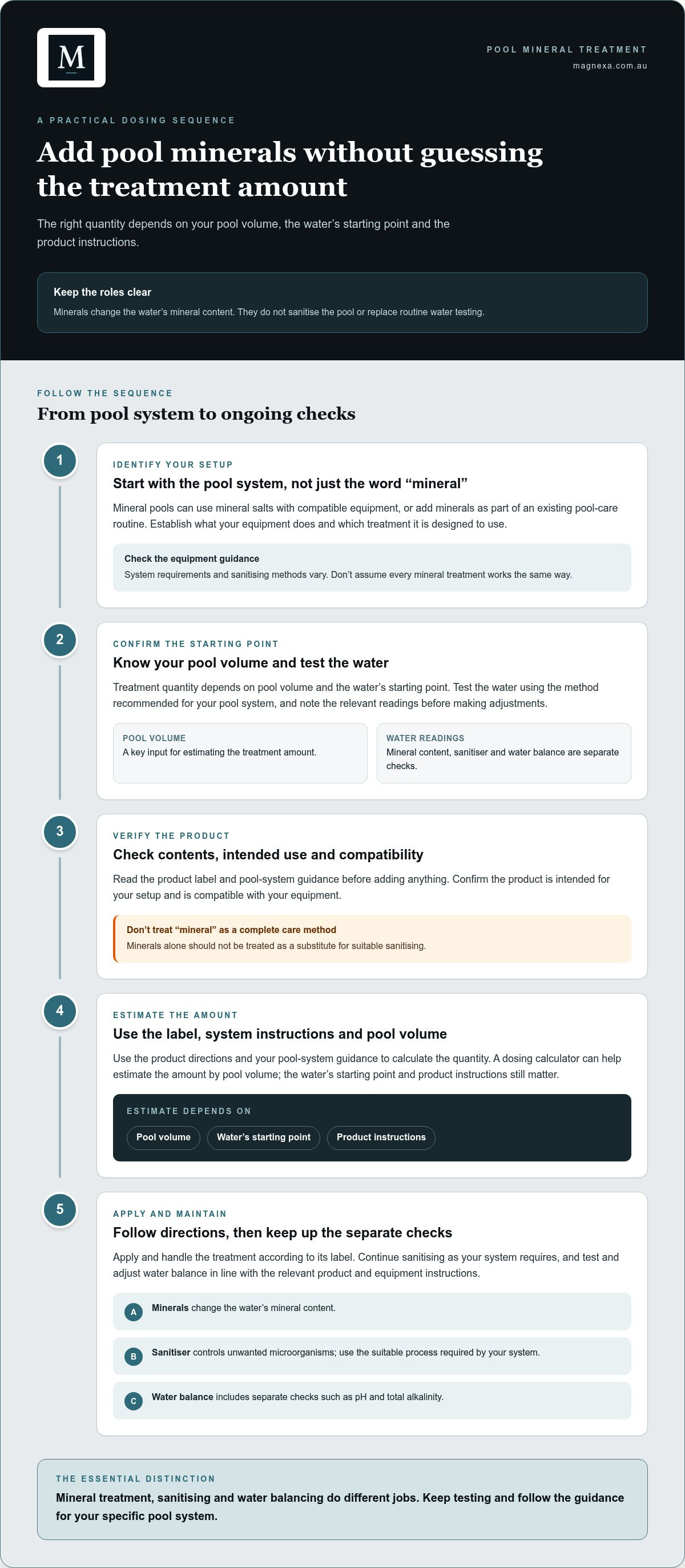
The correct amount depends on pool volume, existing mineral content and the product directions. Guessing from the water’s appearance or using a ratio intended for a different system can lead to an incorrect dose. Use this sequence to plan a pool mineral treatment carefully.
- Identify the pool system. Confirm that the equipment and mineral product are intended to work together. Check the pool-system guidance before adding minerals, especially if you’re converting from another setup.
- Establish the pool volume. Use a measured or documented volume where possible, not a rough visual estimate. Pool volume is a key input when calculating the amount required.
- Test the water first. Record the readings relevant to your system, including mineral levels if the product or equipment instructions call for them. Existing mineral content can affect how much more, if any, is needed.
- Calculate the quantity. Use a pool-volume-based calculator to estimate the amount for the specific product. Magnexa’s dosing calculator uses pool volume to help estimate quantities, but the product label and system guidance remain the final reference.
- Apply and recheck. Follow the product label for adding minerals and operating circulation. Test again at the time and in the manner specified by your pool-system guidance.
Measure the pool and check its starting point
Pool shape and depth can make visual estimates unreliable. Use your pool’s recorded capacity or a careful volume calculation, then test the water before treatment. Don’t combine mineral products or other treatments based on guesswork. Product directions and equipment requirements determine what’s suitable for your setup.
Calculate, add and recheck carefully
A calculator can turn pool volume into a useful quantity estimate, but it can’t replace the directions for a particular mineral product. Follow those directions for application and circulation, then use your pool system’s testing guidance to check the result before making further adjustments. For background on magnesium products, see Magnesium Pool Salt: A Straightforward Guide for Pool Owners.
Enter your pool volume in Magnexa’s dosing calculator to estimate the quantity. Before adding minerals, compare that estimate with the product label and system instructions.
Choosing Pool Mineral Treatment and Supplies in South East Queensland
Before choosing a pool mineral treatment, establish three things: your pool’s volume, the system and equipment already in place, and why you’re adding minerals. Are you topping up an existing mineral pool or planning a conversion? The answer helps narrow down the supply option, but the amount must still be based on pool volume and the relevant product instructions.
Match the mineral supply to the pool
For an existing mineral pool, individual bags may suit a planned addition or replacement, provided the product matches the system and its directions. For a conversion, a starter pack may be the relevant option. Check the product details and pool-system guidance rather than assuming a pack or mineral blend suits every pool.
Magnexa supplies magnesium pool minerals in 10 kg and 25 kg bags, as well as starter packs for mineral pool conversions. Bag size is a supply format, not a dosing recommendation. Use the pool’s measured volume and product directions to determine the appropriate amount. Magnexa’s dosing calculator can help estimate quantities based on pool volume; use the estimate alongside the exact label and equipment guidance.
Product choice also depends on the treatment purpose. Adding minerals to an established system isn’t the same decision as converting a pool. In either case, avoid choosing a quantity by eye or borrowing a treatment ratio from another product. The product directions guide its use, while the pool-system instructions determine compatibility and operation.
Plan the next step for a South East Queensland pool
Magnexa delivers pool minerals across South East Queensland, including Brisbane, Moreton Bay, the Sunshine Coast, Ipswich, Logan, Redlands and the Gold Coast. Pool owners in these areas can order magnesium pool minerals and conversion starter packs for local delivery. This is product supply, not pool maintenance or equipment work.
Have your pool volume and current system details ready before selecting a product. Use the dosing calculator to estimate a quantity, then compare it with the product instructions before adding minerals. To get started, use Magnexa’s dosing calculator or view its magnesium pool minerals in 10 kg and 25 kg bags.
Plan Your Mineral Treatment with the Right Information
A pool mineral treatment works as part of a defined water-care system. Minerals change the water’s mineral content, but they don’t replace sanitising, testing or water-balance adjustments. Before adding them, identify your pool system, confirm the pool volume and follow the product and equipment instructions.
The amount you need depends on pool volume and the product, so avoid relying on a general ratio or visual estimate. Magnexa’s pool-volume-based dosing calculator can help you estimate a quantity. Magnesium pool minerals are available in 10 kg and 25 kg bags, with starter packs for mineral pool conversions and delivery across South East Queensland.
To work out a starting quantity, use the pool mineral dosing calculator. Check its estimate against the product label and your pool-system guidance before adding minerals. With those details in hand, you can choose your next step with more confidence and keep the rest of your pool-care routine on track.
Frequently Asked Questions
What is pool mineral treatment?
Pool mineral treatment means adding minerals to pool water according to the pool system and product instructions. It changes the water’s mineral content, but doesn’t sanitise it by itself or remove the need for routine testing. Dissolved minerals in pool water are different from mineral materials used in a pool finish. Those materials form part of the surface rather than treating the water.
Does pool mineral treatment replace chlorine?
No. Mineral treatment shouldn’t be treated as a replacement for sanitising. A mineral pool still needs an appropriate sanitising process, and the products and settings must suit its equipment. Some systems use a chlorinator as part of that process, but requirements vary. Follow your pool-system and product instructions for compatible sanitiser settings, and continue testing the water as directed.
How much mineral treatment should I add to my pool?
The amount depends on your pool volume, the existing water conditions and the product directions. Use a measured or documented pool volume rather than guessing, then check whether the instructions account for the water’s starting mineral level. A volume-based dosing calculator can help estimate a quantity, but it doesn’t replace product-specific guidance. There isn’t one universal ratio for every mineral product and pool system.
Can I add magnesium minerals to an existing saltwater pool?
It depends on your pool equipment, current system and the mineral product’s instructions. Identify the chlorinator and other relevant equipment, then follow the product and system guidance on compatibility before adding minerals. Don’t assume every saltwater pool can use the same conversion method or dose. If you intend to change systems, refer to a dedicated conversion guide, such as “How to Convert a Standard Salt Pool to Magnesium Without Draining It”.
How often should I test pool water after adding minerals?
There isn’t a fixed testing schedule that suits every pool. Frequency depends on the pool system, conditions and manufacturer guidance. After adding minerals, follow the instructions for when to test and which readings to check, including relevant water-balance measures and sanitiser levels. Keep testing as part of your ongoing pool care. Adding minerals doesn’t remove the need to monitor or adjust the water.
Are magnesium pool minerals the same as pool salt?
Not necessarily. “Pool minerals” and “pool salt” can refer to products with different intended uses or system requirements, so don’t assume they’re interchangeable. Check the product label and your equipment instructions before adding either. Magnexa supplies magnesium pool salt and pool minerals. For more context on magnesium pool salt, read “Magnesium Pool Salt: A Straightforward Guide for Pool Owners” and follow the directions for your chosen product.
Where can I get pool mineral treatment in South East Queensland?
Magnexa supplies magnesium pool minerals in 10 kg and 25 kg bags, plus starter packs for mineral pool conversions, with delivery across South East Queensland. The local area includes Brisbane, Moreton Bay, the Sunshine Coast, Ipswich, Logan, Redlands and the Gold Coast. To estimate the quantity for your pool, use Magnexa’s dosing calculator with your pool volume, then compare the estimate with the product instructions.
Frequently Asked Questions
More articles