How to Convert a Chlorine Pool to a Mineral Pool
3 October 2026 · 14 min read
A mineral pool can still use chlorine. If you want to convert a chlorine pool to a mineral pool, the main change is the water’s mineral balance, not an automatic end to sanitising or regular care. Some systems use a compatible salt chlorinator to produce chlorine, so your existing equipment matters.
Before buying minerals, find out what can stay in place. This guide explains what conversion involves, what usually remains the same and how to plan around your pool’s equipment and water. You’ll also learn how to estimate the mineral quantity for your pool and why it’s important to follow product dosing instructions.
A dosing calculator can help estimate the amount required. For pool owners in South East Queensland, compare that estimate with the available mineral bags or a starter pack. Magnexa delivers pool minerals across the region. The aim is to have a clear plan before adding anything to the water.
Key Takeaways
- To convert a chlorine pool to a mineral pool, plan for a change in water composition, not a switch to chlorine-free water.
- Record your pool volume, current treatment method and equipment before deciding how to approach conversion.
- Test the water and check equipment compatibility before adding minerals, then follow the relevant product directions.
- Use Magnexa’s dosing calculator to estimate the quantity required for your pool.
- Compare 10 kg and 25 kg mineral bags with conversion starter packs. Delivery is available across South East Queensland.
What changes when you convert a chlorine pool to a mineral pool?
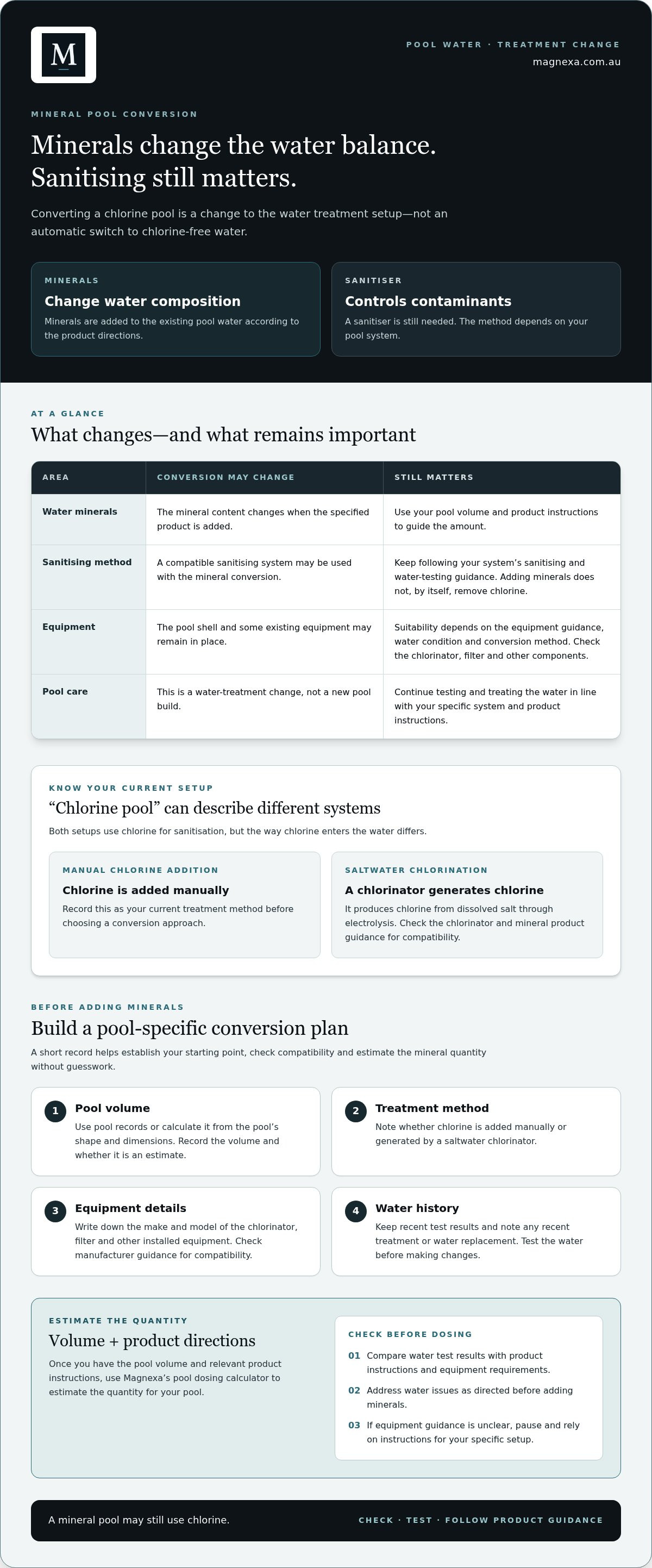
To convert a chlorine pool to a mineral pool, you add minerals to the existing pool water and manage the system according to the product instructions. It’s a change to the water treatment setup, not a new pool build. The pool shell and some existing equipment may remain, but suitability depends on the equipment, water condition and conversion method.
Minerals and sanitisation have different roles. Minerals change the water’s composition. A sanitiser is still needed to control contaminants, and the method depends on your pool system. Don’t assume that adding minerals removes chlorine or changes how your pool should be maintained.
Does a mineral pool still use chlorine?
It may. Some mineral pool systems use a compatible salt chlorinator to generate chlorine for sanitisation. Other systems may have different requirements. Don’t treat minerals as a substitute for a sanitiser unless the product instructions explain how the system works.
Salt water chlorination uses electrolysis to produce chlorine from dissolved salts. Read about salt water chlorination, then check your chlorinator and mineral product guidance to understand what applies to your pool. Continue following the water testing and treatment instructions for your specific setup.
Is a chlorine pool the same as a saltwater pool?
Not necessarily. A pool described as a chlorine pool may be sanitised by manually adding chlorine. A saltwater pool typically has a chlorinator that generates chlorine from dissolved salt. Both use chlorine for sanitisation, but the way chlorine enters the water differs.
Identify your current setup before choosing a conversion approach. Note whether chlorine is added manually or generated by a chlorinator, and record the equipment model. This helps you assess whether the mineral product and existing system are suited to work together. For a practical sequence, see the mineral pool conversion step-by-step guide.
Your next steps depend on the whole pool system, not just the product you plan to add. Start by testing the water to establish a baseline and checking the product’s compatibility and dosing instructions. If the water needs attention, address it as directed before adding minerals. This makes the conversion plan specific to your pool’s actual condition.
Check your pool water and equipment before adding minerals
Before you plan to convert a chlorine pool to a mineral pool, collect the details that determine how much mineral product you’ll need and whether your current system suits the conversion. A short record gives you a useful baseline and helps prevent guesswork.
What information should you gather first?
Start with the pool volume. Use existing pool records or calculate it from the pool’s shape and dimensions. An estimate that’s too high or low can affect your mineral quantity calculation, so note how you arrived at the figure.
- Pool volume: Record the volume and whether it’s an estimate.
- Treatment method: Note whether chlorine is added manually or generated by a saltwater chlorinator.
- Equipment: Write down the make and model of the chlorinator, filter and other installed equipment.
- Water history: Keep recent test results and note any recent treatment or water replacement.
These details help distinguish a routine mineral addition from a conversion that needs closer planning. For background on mineral types and their use in pools, read the straightforward magnesium pool salt guide.
Which equipment and water checks matter?
Test the pool water before making changes and record the results. The purpose is to understand the starting condition, not to assume a particular target reading. Compare the results with the mineral product instructions and the requirements for your existing treatment system. A general reference such as the PHTA’s pool and spa resources can provide further water-care context, but your product and equipment documentation should guide the conversion.
Check the manufacturer’s guidance for the chlorinator, filter and other equipment that will remain in use. Look for information about mineral or salt levels, water chemistry and compatibility. Having a chlorinator does not, by itself, establish that it suits every mineral product.
If you can’t find the equipment details or the guidance is unclear, pause before adding minerals. Use the instructions for your specific setup rather than relying on a general dosing rule. Once you have the pool volume and relevant product directions, use Magnexa’s pool dosing calculator to estimate the quantity for your pool. This gives you a practical starting point for choosing mineral bags or a conversion starter pack.
What mineral conversion changes, and what it does not
A mineral conversion changes the composition of the pool water by adding minerals according to the product directions. It doesn’t, by itself, make the pool chlorine-free or remove the need to test and treat the water. The effect on your setup depends on your equipment, starting water condition and the conversion instructions.
| Area | What may change | What still matters |
|---|---|---|
| Water minerals | The mineral content changes when the specified product is added. | Use the product instructions and pool volume to guide the amount. |
| Sanitising method | The conversion may be used with a compatible sanitising system. | Keep following your system’s sanitising and testing guidance. |
| Equipment | Some existing equipment may remain in use, depending on its guidance. | Check compatibility for the chlorinator, filter and other components. |
| Water care | The water composition changes. | Ongoing testing and water balancing remain part of pool care. |
Minerals and sanitisation do different jobs
Minerals are added to the water, while sanitisation is handled by the pool’s treatment system. In systems that use a salt chlorinator, the chlorinator generates chlorine for sanitising. Don’t assume this applies to every setup. Check your system and product instructions, and continue testing and treating the water as directed. The CDC’s Model Aquatic Health Code is a US aquatic-facility resource, not Australian pool guidance, but it illustrates why water treatment and safety procedures remain important.
Minerals do not automatically replace chlorine. If you want to convert a chlorine pool to a mineral pool, plan for the sanitising method to continue unless the instructions for your specific system state otherwise. A change in mineral content alone doesn’t show that the water is sanitised.
Does conversion mean draining or replacing equipment?
There isn’t one answer for every pool. Draining isn’t an automatic requirement, and neither is replacing the chlorinator. The decision depends on the current water condition, equipment guidance and the mineral product’s conversion instructions. Don’t assume an existing chlorinator, filter or pool component is compatible without checking its documentation.
If the instructions call for a particular water condition or equipment setup, follow them before adding minerals. If they’re unclear, pause and resolve the uncertainty rather than making an unverified change. This keeps the conversion based on your pool’s requirements, not a blanket rule.
How to convert a chlorine pool to a mineral pool
Work through the conversion in order. The right mineral quantity and addition method depend on your pool volume, current water condition, equipment and product directions. Check the water and confirm how your existing system should operate with the minerals before adding them.
- Record your pool details. Note the pool volume, current treatment method and the equipment you plan to keep in use.
- Test the water. Record the results as a baseline and follow your pool system’s guidance if the water needs attention before conversion.
- Check compatibility and instructions. Read the guidance for your chlorinator and other equipment, along with the mineral product label. If the instructions are unclear, pause rather than guessing.
- Calculate the mineral quantity. Enter your pool volume in Magnexa’s dosing calculator. Use the estimate alongside the product directions and your pool’s water condition, not as a substitute for them.
- Add minerals as directed. Follow the label for the amount and method of addition. Don’t assume a generic dose or apply instructions from a different product.
- Retest and continue care. Check the water afterwards as directed, then keep up the sanitising and testing required by your pool system.
Calculate the mineral quantity for your pool
Pool volume is the starting point for estimating how much mineral product is required. Enter the volume you recorded into Magnexa’s dosing calculator rather than relying on a quantity from another pool. The starting water condition and product instructions also shape the conversion plan. Treat the calculator result as an estimate, then follow the relevant label and system guidance before adding anything.
Add minerals and check the water afterwards
Use the product directions for preparing and adding the minerals, and follow any instructions that apply to your chlorinator and filtration system. Don’t invent a waiting period or change the normal sanitising routine without guidance for your setup. After adding the product, test the water and use the relevant system instructions to decide what needs attention. Mineral addition doesn’t remove the need for ongoing sanitisation.
Test, calculate, add as directed, then retest. This sequence keeps the conversion tied to your pool’s volume, water and product guidance. To estimate the quantity for your pool, use Magnexa’s dosing calculator.
Plan your mineral pool conversion and source minerals in South East Queensland
A clear conversion plan follows a simple order: identify your current treatment system, check the water and equipment, calculate the mineral quantity, then follow the product directions. This helps you choose supplies based on your pool rather than a general estimate, while keeping the sanitising system and its ongoing care in view.
Choose a mineral quantity using your pool volume
Before choosing a supply option, have your pool volume and system details ready. Use Magnexa’s dosing calculator to estimate the quantity for your pool, then refer to the mineral product instructions for how to apply it. The calculator provides a pool-specific estimate; it doesn’t replace directions that account for product use or your pool’s water condition.
Magnexa supplies pool minerals in 10 kg and 25 kg bags, as well as conversion starter packs. These are supply options for different conversion plans, not a substitute for calculating the amount your pool requires. Use the estimate and applicable product directions to decide which option suits your plan. Don’t assume a particular pack contains extra equipment or chemicals.
What to do next in South East Queensland
Magnexa delivers pool minerals across South East Queensland, including Brisbane, Moreton Bay, the Sunshine Coast, Ipswich, Logan, Redlands and the Gold Coast. Before calculating, gather your pool volume, current treatment method and equipment details. If you’re still working out how to convert a chlorine pool to a mineral pool, use those details to make the next steps specific to your setup.
Once you have the estimate, follow the relevant product and system instructions before adding minerals. Continue the sanitising and water-testing routine required for your pool. Changing the mineral content is not a reason to set aside normal water care.
Use the dosing calculator and plan your conversion when you’re ready to estimate the quantity and choose the mineral bags or starter pack that fits your approach.
Plan your conversion with the right pool details
To convert a chlorine pool to a mineral pool, start with your existing system and water, not a guess about how much mineral salt to add. Record the pool volume, identify how chlorine is supplied, and check water results, equipment guidance and product directions before adding minerals. A mineral conversion doesn’t automatically remove chlorine or ongoing testing and sanitising.
Magnexa’s pool-volume dosing calculator can help estimate the quantity for your pool. You can then consider 10 kg or 25 kg mineral bags, or a conversion starter pack, and follow the relevant product instructions. Delivery is available across South East Queensland, including Brisbane, Moreton Bay, the Sunshine Coast, Ipswich, Logan, Redlands and the Gold Coast.
Use Magnexa’s dosing calculator to plan your mineral conversion with your pool details in hand. A measured first step makes it easier to choose a suitable supply option and move ahead with a clear plan.
Frequently Asked Questions
Can I convert a chlorine pool to a mineral pool without draining it?
You can often convert a chlorine pool to a mineral pool without draining, but it isn’t a rule for every pool. The decision depends on the starting water condition, your equipment and the mineral product’s instructions. Test the water and check the system guidance first. If the directions require a different starting condition or water replacement, follow them rather than assuming the existing water is ready.
Does a mineral pool still need chlorine?
Yes, a mineral pool may still use chlorine for sanitisation. In some systems, a compatible saltwater chlorinator generates chlorine; other setups may use a different treatment method. Minerals and sanitisation have separate roles, so adding minerals doesn’t automatically make the water chlorine-free. Keep testing and treating the pool according to the instructions for your specific system and mineral product.
How much mineral salt should I add to my pool?
The amount depends on your pool volume, current water condition and product instructions. Record the pool volume, then use Magnexa’s dosing calculator to estimate the quantity for your pool. Treat the result as an estimate and follow the current product directions when adding minerals. Don’t copy a dose from another pool, since its volume and starting water may differ.
Will my existing saltwater chlorinator work with a mineral pool?
It may, but compatibility depends on the chlorinator model and the mineral product. Check the manufacturer’s guidance for permitted mineral or salt levels and operating requirements before adding anything. If you can’t find the instructions or they don’t clearly cover your intended setup, pause and verify them. Don’t assume every saltwater chlorinator is suitable for every mineral conversion.
Do I need to change my pool equipment to convert to minerals?
Not necessarily. Some equipment may remain in use, depending on its specifications and the product directions. Check the documentation for your chlorinator, filter and other components that will continue operating with the converted water. If a component’s compatibility is unclear, resolve that before adding minerals. A conversion doesn’t automatically mean all equipment must be replaced, or that every existing component will suit the new setup.
How long does it take to convert a chlorine pool to a mineral pool?
There isn’t one conversion timeframe for every pool. The time needed depends on preparation, the condition of the water, equipment checks and the product’s addition and retesting instructions. Follow the directions for your system rather than relying on a general timeline. Magnexa supplies minerals and starter packs across Brisbane, Moreton Bay, the Sunshine Coast, Ipswich, Logan, Redlands and the Gold Coast.
Frequently Asked Questions
More articles