Pool Mineral Balance Guide: A Practical Water-Care Checklist
5 October 2026 · 14 min read
What if cloudy water isn’t a sign that your pool needs more minerals? In a mineral pool, several readings affect water quality, and changing one without checking the others can make troubleshooting harder. This pool mineral balance guide gives you a clear order for testing and responding to common changes.
It’s reasonable to wonder which readings matter, how often to check them and whether minerals replace sanitiser. They don’t: mineral care is one part of water balance, while sanitisation remains a separate requirement. Test consistently, compare results with your pool-system instructions and product label, then make one adjustment at a time. The checklist below covers the core readings, how to investigate cloudy water or shifting results, and when mineral additions may be relevant. The aim is a repeatable routine that helps you care for your water without guessing or changing several things at once.
Key Takeaways
- This pool mineral balance guide shows how to assess minerals as one part of your pool’s wider water chemistry.
- Minerals don’t remove the need to manage sanitiser. Check your pool-system instructions before interpreting readings or making changes.
- Cloudiness, deposits or an unusual feel are clues, not diagnoses. Test the water before deciding what to adjust.
- Use a repeatable routine: inspect, test, record, compare, adjust one factor and retest.
- Base mineral additions on the measured level, pool volume and product instructions. Use the Dosing Calculator to work out the quantity needed.
Pool mineral balance guide: what a balanced pool actually means
A balanced pool has readings that suit its equipment, treatment system and care instructions. There isn’t one target that applies to every mineral pool. Mineral content is one part of water chemistry, not a complete maintenance system. Start by checking the key readings together, then compare them with the product label and pool-system manufacturer’s instructions.
Keep four checks in view: pH, total alkalinity, sanitiser level and calcium hardness. Each describes a different part of the water. Your mineral level could be within the system’s recommended range while another reading needs attention. Treating “mineral balance” as a single number can hide the cause of a problem.
Which pool water readings belong on the checklist?
pH measures how acidic or alkaline the water is. It affects the conditions in which the pool’s treatment works, so read a sanitiser result alongside pH, not in isolation.
Total alkalinity helps resist sudden pH movement. It’s related to pH, but the readings aren’t interchangeable: pH measures acidity or alkalinity, while total alkalinity indicates the water’s capacity to buffer pH changes.
Sanitiser level is a separate check of the treatment used to control unwanted organisms in the water. Calcium hardness measures dissolved calcium. The suitable level depends on the pool system and surfaces. Checking it can help identify whether water conditions may contribute to deposits or other balance issues. The overview of swimming pool sanitation methods provides useful background on how water chemistry and sanitation relate.
Do minerals sanitise a pool by themselves?
No. Mineral content doesn’t automatically replace the pool’s sanitising system. The required treatment and operating instructions depend on the equipment and products used, so follow the guidance for your specific system. Don’t lower or stop sanitiser just because minerals are present. Check the relevant instructions and test results first.
Mineral balance concerns the mineral level; sanitation concerns how the pool’s treatment controls water quality.
Keep readings and adjustments in a simple record. If a result shifts, you can see which parameter changed instead of adding minerals or other treatments by guesswork. Use the target ranges and testing directions supplied for your pool system and products, and make one correction at a time.
How mineral content, sanitiser and water chemistry work together
Mineral content is one reading within a working pool system. It doesn’t remove the need to maintain sanitiser, check pH or keep water circulating through the filter. Each has a different role, so a problem in one area shouldn’t automatically trigger a change in another.
What does each part of mineral pool care do?
- Mineral additions bring mineral content towards the level specified for the pool system. They don’t correct every water-quality issue.
- Sanitiser is the treatment used to control unwanted organisms. Minerals don’t automatically replace it, so manage sanitiser as directed for your equipment and treatment.
- pH management keeps acidity or alkalinity within the range required by the system. pH can affect how well some sanitisers work, so interpret a sanitiser result alongside the pH reading.
- Filtration circulates water and captures particles that pass through the filter. It has a different role from chemical treatment and mineral balance.
Use the product label and equipment instructions for target ranges, adjustment steps and safe handling. The CDC’s guidance on pool chemical safety is a useful reference when handling and storing pool treatments.
For example, a mineral reading might already suit the pool system while pH is outside its recommended range or the sanitiser reading needs attention. Adding more minerals won’t address the reading that’s out of range. Check each result against its own instructions before deciding what to adjust.
Why should you test before adding a treatment?
Record the readings before making a change. If you add several products at once and then retest, it’s harder to tell which change affected the result. Instead, use this pool mineral balance guide approach: test, identify the reading that needs attention, adjust one factor according to its instructions, then retest as directed.
Test first, so each adjustment has a clear reason and its effect can be checked.
If your results show that mineral content needs adjusting, base the quantity on your pool volume, measured level and product instructions. Magnexa’s magnesium pool minerals and Dosing Calculator can help you work out the mineral quantity for your pool.
How to read common mineral pool problems before changing the water
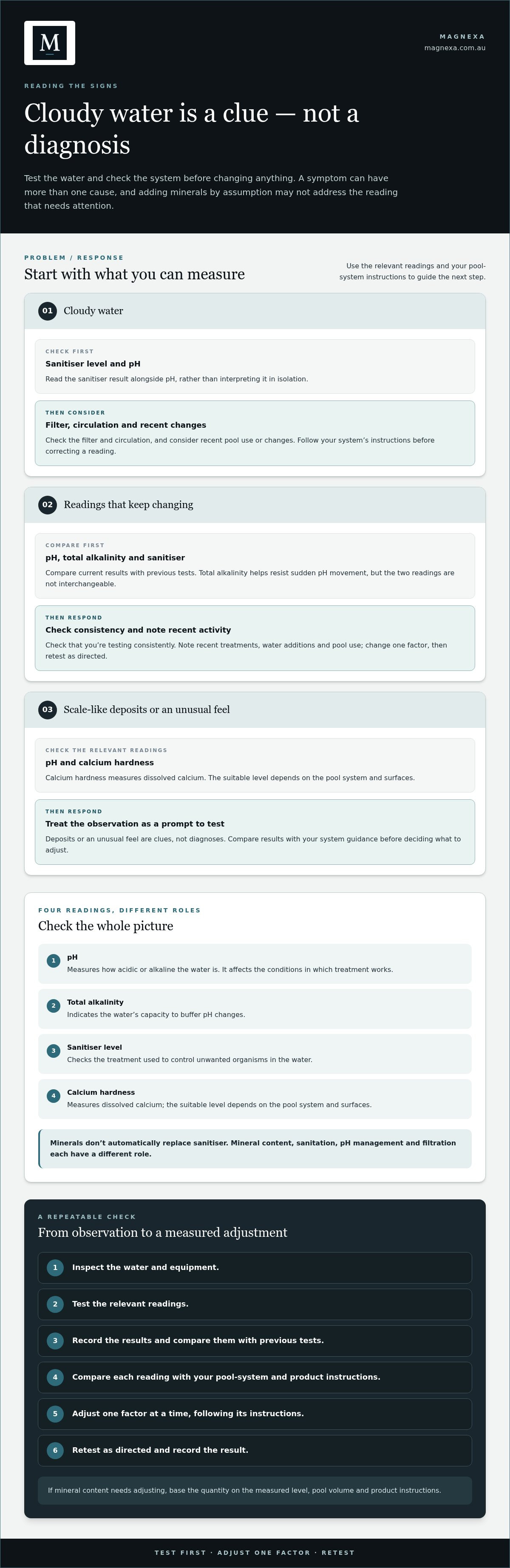
A symptom is a reason to test, not a diagnosis. Cloudiness, deposits or an unusual feel can have more than one cause. Check the readings, consider filtration and recent pool use, then make one evidence-based adjustment rather than adding minerals by assumption.
| Observation | First reading to check | Sensible next step |
|---|---|---|
| Cloudy water | Sanitiser and pH | Check the filter and circulation, and consider recent pool use or changes. Follow your system’s instructions before correcting a reading. |
| Readings that keep changing | Compare pH, total alkalinity and sanitiser with previous test results | Check that you’re testing consistently and note recent treatments, water additions and pool use. Change one factor, then retest as directed. |
| Scale-like deposits | pH and calcium hardness | Compare both results with your system’s guidance. Don’t assume the deposit means the mineral level is wrong. |
| Water feels different | pH and sanitiser | Record what you notice and test the water. Feel alone can’t identify which reading, if any, needs attention. |
What should you check if mineral pool water looks cloudy?
Start with a fresh water test. Check sanitiser and pH, then see whether the filtration system is operating as expected. Consider recent pool use and any treatment or water changes. Don’t add clarifier or minerals just because the water looks cloudy. If you correct a reading or address filtration, retest before making another adjustment. The CDC guidelines for pool operation offer additional background on water chemistry and pool operation. Follow your own pool system’s instructions for its targets and procedures.
What can changing readings or deposits indicate?
Compare current results with your previous test record. A shift in pH, total alkalinity or sanitiser can help narrow down what has changed. For deposits, check pH and calcium hardness against the system guidance. Neither deposits nor an unusual feel prove that magnesium content is responsible. Use test results before considering a mineral adjustment.
For pools in South East Queensland, rain, heat and heavy use are practical reasons to retest, as they can coincide with changes in pool conditions. Record what happened alongside the readings. That context helps you spot patterns without changing several parts of the water at once.
A repeatable pool mineral balance checklist for weekly and follow-up checks
A steady routine makes changes easier to trace. Use this pool mineral balance guide checklist at the frequency directed by your test kit and pool-system instructions. Testing needs can vary with pool use and conditions, so follow the guidance for your equipment rather than relying on one schedule for every pool.
What should a regular mineral pool check include?
- Inspect. Look at the water, check that circulation is working as expected and note visible changes to pool surfaces.
- Test. Check the readings required for your sanitising and mineral system. Follow the kit instructions for taking and reading a sample.
- Record. Write down each result before deciding whether an adjustment is needed.
- Compare. Check readings against your pool-system guidance and previous results. Look for a change, not just a single result in isolation.
- Adjust one factor. If a reading needs attention, follow the relevant product label and equipment instructions. Don’t make several changes at once.
- Retest. Follow the product label for when and how to check the water again. Record the result before considering another adjustment.
A simple log can be kept in a notebook or spreadsheet:
- Date and time: when you tested.
- Readings: each result, with its unit if shown by the kit.
- Recent conditions: weather, heavy rain or heavier-than-usual pool use.
- Additions: product and amount added, if applicable.
- Retest: time and results after the adjustment.
What should you do after adjusting pool water?
Use the product label for application and circulation directions, and for the timing of a follow-up test. Wait for the stated retest point before judging the result. Adding another treatment too soon can make it difficult to tell whether the first adjustment worked or what caused a new reading.
In South East Queensland, heavy rain or unusually heavy pool use are sensible prompts to check the water again, alongside the testing frequency specified for your system. Keep results in your log so you can compare conditions and readings over time.
If testing shows that mineral content needs adjustment, base the quantity on your pool volume, measured results and product instructions. Use the Dosing Calculator to work out your mineral quantity.
When to adjust mineral levels and where to source them
Mineral additions make sense when a test shows the level is outside the range specified for your pool system. Use the testing method required by the system, then compare the result with the product label and equipment guidance. A cloudy appearance or unusual feel isn’t evidence on its own that minerals are low. Test first, then address the reading that actually needs attention.
How do you know whether your pool needs more minerals?
Check the current mineral level using the method specified for your pool system. If the result is within the applicable range, adding more may be unnecessary, even if another water issue needs attention. If the result is outside that range, use the system’s instructions to determine whether an addition is appropriate. Don’t infer mineral levels from water clarity, colour or feel.
How can pool owners calculate a suitable mineral quantity?
Use your recorded pool volume and current measured mineral level, then follow the product instructions for calculating and applying an addition. Pool volume matters: an estimate that’s too high or low can lead to an unsuitable quantity. Magnexa’s Dosing Calculator helps pool owners work out mineral quantities. Use it alongside the current test result and applicable product guidance, not as a substitute for either.
For broader product context, refer to the magnesium pool salt guide. If you’re changing pool type, the mineral pool conversion guide is the relevant starting point. Both topics help frame the decision; the amount to add still depends on your pool’s volume, measured level and system requirements.
Magnexa supplies magnesium pool minerals in 10 kg and 25 kg bags, with delivery across South East Queensland, including Brisbane, Moreton Bay, the Sunshine Coast, Ipswich, Logan, Redlands and the Gold Coast. If you’re in the region and exploring pool minerals, review the product information and use your pool’s test results to guide the next step.
Keep your pool care consistent
A reliable pool mineral balance guide comes down to a few steady habits: test the readings your system requires, record changes and adjust one factor at a time. Minerals are only one part of water care, so don’t treat a cloudy appearance or unusual feel as proof that more minerals are needed. Use test results, pool volume and your system’s instructions to decide what to do next.
Retest after an adjustment and keep the result in your log. Over time, those records make it easier to spot patterns and respond without guesswork. If your measured mineral level calls for an addition, Magnexa’s Dosing Calculator can help work out a quantity based on your pool. Pool minerals are delivered across South East Queensland, including Brisbane, Moreton Bay, the Sunshine Coast, Ipswich, Logan, Redlands and the Gold Coast.
Explore Magnexa magnesium pool minerals and use the Dosing Calculator for your South East Queensland pool. With a consistent checklist and clear records, you can keep water care practical and manageable.
Frequently Asked Questions
How often should I test the water in a mineral pool?
Test at the frequency recommended by your test kit and pool-system instructions. The right cadence depends on how often the pool is used, changing conditions and the requirements of your equipment and treatment. Record the date and results so you can compare readings over time. After an adjustment, retest as directed by the product label before making another change. Test sooner if conditions or pool use change noticeably.
Do magnesium minerals replace chlorine or another pool sanitiser?
No. Magnesium minerals don’t automatically replace chlorine or another sanitiser. Mineral content and sanitation have different roles in pool care, so continue to manage the sanitiser required by your pool equipment and treatment system. Follow the system’s instructions for suitable readings and adjustments. Don’t reduce or stop sanitiser just because minerals are present. Test the water and use the relevant product label and equipment guidance to decide what action is needed.
What should I test first if my mineral pool water turns cloudy?
Test the water before adding any treatment. Check sanitiser and pH first, then review filtration and circulation, recent pool use and any changes to the water. Cloudiness alone can’t identify the cause, so don’t assume the pool needs more minerals or clarifier. Compare results with your system’s instructions. If you make a correction, follow the product directions and retest before deciding whether another adjustment is needed.
Can I add minerals when my pool water is out of balance?
First identify which reading is outside the guidance for your pool system. A mineral reading may be suitable even if pH, sanitiser or another parameter needs attention. Use the specified test method, compare the result with the product label and equipment instructions, then choose an adjustment for that reading. Don’t add minerals just because the water looks cloudy or feels different. Retest after a change as directed before adding anything else.
What happens if my pool’s pH keeps changing?
Record each pH result and check total alkalinity, which helps stabilise pH but is a separate reading. Compare both results with the guidance for your pool system and note recent treatments or changes in pool conditions. Avoid repeatedly adjusting pH without checking the related readings. Follow the equipment and product instructions for any correction, then retest at the specified time. A record of results helps show whether the pattern continues.
How do I work out how much magnesium to add to my pool?
Use your pool’s volume, its current measured mineral level and the product instructions to work out the quantity. The required amount depends on these details and the needs of your pool system, so don’t estimate from water appearance alone. Magnexa’s Dosing Calculator helps pool owners determine a mineral quantity. Enter accurate pool information, then use the product label and equipment guidance when applying an addition.
Does heavy rain affect mineral pool water balance in South East Queensland?
Heavy rain can change pool conditions, so use it as a prompt to test rather than assume a particular correction is needed. This is relevant for pool owners across Brisbane, Moreton Bay, the Sunshine Coast, Ipswich, Logan, Redlands and the Gold Coast. Check the readings required by your system, compare them with its instructions and record the results. Adjust only if a test shows a reading needs attention, then retest as directed.
Frequently Asked Questions
More articles