Magnesium Pool Benefits: What the Water Can and Cannot Do
10 October 2026 · 16 min read
The most credible magnesium pool benefits are about the swimming experience, not medical effects. Some swimmers describe mineral water as softer or silkier, and that different feel may appeal to people who swim regularly. But “softer” is a sensory description: magnesium increases water hardness, and evidence that swimming lets the body absorb meaningful amounts of magnesium through the skin remains limited. Knowing the difference helps you weigh a personal preference without relying on a health promise.
A magnesium pool still needs effective sanitation and balanced water chemistry. Minerals do not replace the sanitising system or routine pool care. This guide explains what magnesium minerals change, which skin and wellness claims need caution, and how to compare a mineral pool with a conventionally sanitised pool. You’ll find practical criteria for deciding whether the water feel and conversion requirements suit your household, without treating mineral content as a medical treatment.
Key Takeaways
- Assess magnesium pool benefits as a water-experience preference, not a promise of medical results.
- Consider how mineral composition and balanced water chemistry shape the feel of a swim.
- Separate personal reports of skin comfort or relaxation from established clinical evidence.
- Before choosing a mineral pool, weigh swimming comfort, care expectations, equipment and household preferences.
- If you decide to explore a conversion, Magnexa offers 10 kg and 25 kg bags, starter packs and a dosing calculator to estimate quantities.
Magnesium pool benefits: what changes when you swim?
Magnesium minerals change the pool-water experience, not the pool’s purpose. A pool remains a place to swim and needs suitable sanitation and water balance, whether or not its water contains magnesium minerals. The practical question is whether you prefer the water’s feel and are comfortable with the care the pool requires.
A mineral pool is a pool-water choice, not a treatment pool. Some owners describe the water as softer or silkier, while others simply prefer how it feels during a swim. These are personal impressions, not guaranteed outcomes. The experience depends on the water’s balance, the mineral formulation and each swimmer’s perception.
That distinction matters when weighing magnesium pool benefits. Magnesium has recognised roles in the body, as outlined in Magnesium in biology, but that does not establish that swimming in mineral-treated water delivers a health benefit. The water’s composition and the body’s response are separate questions.
What does magnesium pool water mean?
The term describes pool water treated with minerals that contain magnesium. It does not refer to one universal recipe. Mineral products can use different formulations, so the mineral mix and resulting water composition may vary. The name alone does not tell you exactly how the water will feel or what the pool requires. For a closer look at the material itself, see this straightforward guide to magnesium pool salt.
Which benefits do pool owners usually want to understand?
Most questions are about water feel, swimming comfort and whether a change makes sense for everyone at home. One swimmer may enjoy the sensation while another notices little difference. Personal reports can describe an experience, but they are not proof of a medical effect. Claims about skin improvement, relaxation or other health outcomes need stronger evidence than a pleasant swim or an individual account.
Start with what you can assess directly: how the water feels during ordinary swimming, whether household members prefer it, and whether the pool remains properly balanced. Mineral content is one part of the overall water experience, not a stand-alone measure of comfort. Water management and mineral formulation both contribute to what swimmers notice.
Keep expectations specific. You might prefer the feel of one pool over another, but that preference does not show that magnesium has been absorbed through your skin or changed your health. Treat sensory descriptions as personal observations, and judge medical claims by evidence rather than by magnesium’s role in the body. The next sections look at what mineral content means for pool water and which claims warrant caution.
How magnesium minerals affect the pool-water experience
Dissolved minerals contribute to a pool’s overall water composition. In a magnesium mineral pool, they are part of the water swimmers encounter, but they do not do every job the pool needs. Water balance describes whether the water’s chemical conditions are within suitable ranges. Sanitation is a separate function that controls harmful microorganisms. Mineral content alone does not make pool water safe to swim in.
Mineral content describes what’s dissolved in the water; sanitation is what keeps pool water hygienic. Treating these as separate parts of pool care avoids a common misunderstanding. A mineral pool still needs an appropriate sanitation method and a maintenance plan. Requirements depend on the system, product formulation and pool setup, so follow the relevant product and equipment instructions rather than applying one set of chemical directions to every pool.
Minerals, water balance and sanitation are different things
Think of these as three related but distinct considerations. Minerals describe the dissolved ingredients. Water balance concerns the water’s chemical condition. Sanitation addresses hygiene. A pool can contain magnesium minerals and still need its sanitation system to operate correctly. Changing the mineral content is not a substitute for monitoring and maintaining the pool according to the system’s instructions.
This distinction matters during a conversion as well. The mineral product, existing pool equipment and sanitation approach need to work as a complete setup. Do not assume a bag of minerals replaces a sanitiser, or that instructions for one system apply to another. Product guidance is the practical reference for adding minerals and managing the water after a change.
Why can mineral water feel different?
Some swimmers describe mineral water as softer or silkier. That wording reports a sensation, not a measured change in softness or a guaranteed result. The feel of a swim can depend on more than the mineral ingredients. Water balance, sanitation and other pool conditions also shape the experience, and individual swimmers may notice those conditions differently.
The same mineral formulation will not necessarily feel identical in every pool. If the water is poorly balanced, adding minerals alone will not ensure a more comfortable swim. Likewise, a swimmer’s preference for one pool’s feel does not prove that magnesium has produced a health effect. The National Institutes of Health explains magnesium’s roles in the body in its Magnesium: Fact Sheet for Consumers, but those roles do not show that magnesium in pool water is absorbed in a meaningful amount.
If you’re considering magnesium pool benefits, assess the water as a whole. Consider the mineral formulation, water balance, sanitation and maintenance requirements together. If you’re weighing magnesium pool salt as part of that decision, explore Magnexa’s magnesium pool minerals and use the product guidance to understand how they fit your pool setup.
Magnesium pool benefits versus the claims: what is realistic?
A pleasant swim is a real experience, but it is not proof of a medical effect. This is the key distinction when assessing claims about magnesium pool benefits. A swimmer may enjoy the water or feel relaxed afterwards, but that response alone cannot show that magnesium caused a health change.
Magnesium has important roles in the body, as the US National Institutes of Health explains in its Magnesium: Fact Sheet for Consumers. However, that information concerns magnesium in the body. It is not evidence that swimming in mineral water supplies magnesium through the skin at a therapeutic dose. Assess these claims separately.
Water comfort is not the same as a proven health benefit
A swimmer’s impression that water feels softer or more comfortable can be genuine. It remains a personal observation, not a clinical result. People may also feel relaxed after swimming because of the activity, time spent unwinding or simply enjoying the water. That does not establish that magnesium in the pool produced the effect.
Skin-comfort claims need the same care. Someone may report that their skin feels better after swimming, but an individual account cannot establish that mineral water treats a skin condition or works the same way for other people. Current evidence does not support presenting a magnesium pool as a treatment for eczema, pain or poor circulation, or as a way to detoxify the body. Do not infer a therapeutic benefit from magnesium’s role in normal body processes.
Pool benefits should be described as swimming preferences, not medical treatment, unless reliable clinical evidence supports the health claim.
What a magnesium pool cannot promise
Mineral water is not a substitute for medical care, prescribed treatment or advice from a health professional. If you have a skin condition or ongoing symptoms, a change in pool minerals should not replace care recommended for you. Choose a pool product for the water setup and the experience your household prefers, not as a health intervention.
Adding magnesium does not mean a pool is chlorine-free or that all irritation will disappear. Sanitation arrangements vary, and irritation can have more than one cause. The water’s condition, the sanitation system and a swimmer’s individual sensitivity may all matter. A mineral formulation cannot guarantee that every swimmer will notice the same comfort or avoid irritation.
For a practical decision, separate what you can observe from what would require medical evidence. You can decide whether you like the water’s feel and whether the pool setup suits your household. Treat claims about treating conditions, changing circulation or delivering magnesium through the skin with caution. This keeps the decision grounded in the swimming experience, rather than promises the water cannot substantiate.
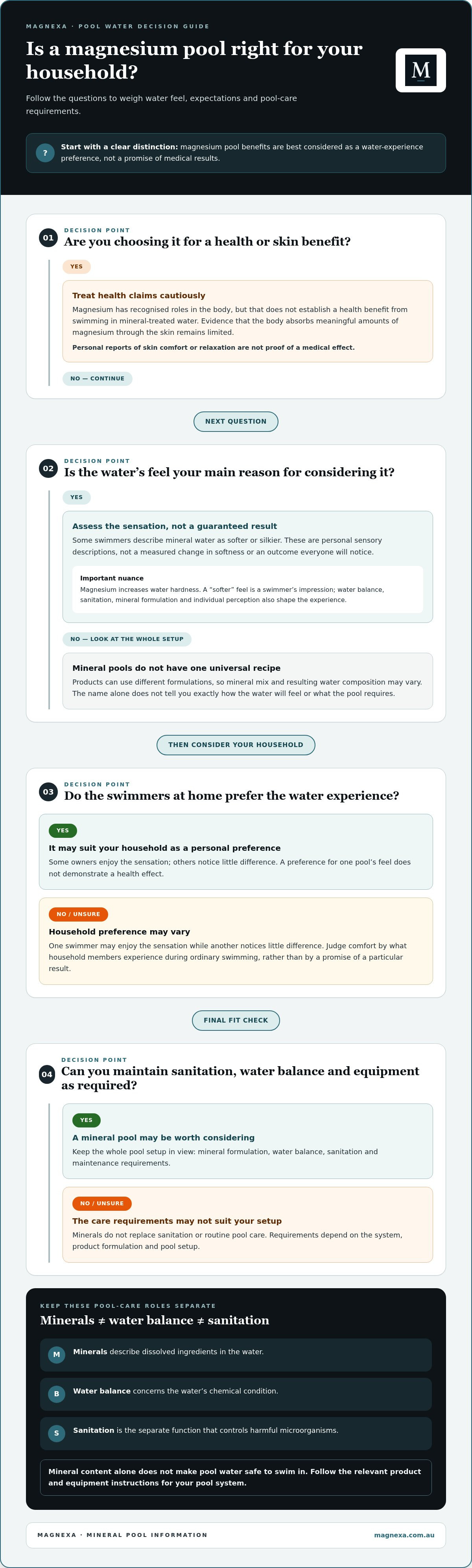
Deciding if magnesium pool benefits suit your household
Choose mineral water for reasons you can assess at home, not because a product claim sounds impressive. The magnesium pool benefits that matter most to you may be a preferred water feel or a pool setup your household is interested in. Use a simple decision sequence to weigh those priorities before working out quantities or conversion details.
A practical checklist before choosing mineral water
- Name the main goal. Are you looking for a different water feel, a mineral-pool setup or simply a pool your household enjoys using? A clear priority makes it easier to judge whether the change is worthwhile.
- Consider who swims. Household members may have different preferences. One person might notice a change while another does not. Treat comfort as an individual preference, not a result everyone should expect.
- Factor in the pool you already have. Note your current equipment and sanitation system, along with the maintenance routine you follow. A mineral change needs to fit the whole pool setup. Use the relevant product and equipment instructions to understand what the change involves.
- Check your expectations. Separate descriptions of water feel from claims about health. Look for clear product guidance, and do not treat personal reports as proof of a medical outcome.
This order keeps the decision practical. If the main reason for changing is a health claim, pause and look for reliable clinical evidence before treating it as a benefit. If your interest is the swimming experience, focus on whether the water and care requirements suit the people who will use the pool.
Keep the changeover and quantity questions in the right place
If you’re considering a conversion, the magnesium pool conversion step-by-step guide covers the changeover process in more detail. This benefits article is not a substitute for product-specific conversion instructions, which matter for your particular pool and equipment.
Quantity planning is a separate step. The right amount depends on pool volume and the selected product’s instructions, so there is no universal dose for every pool. Use the magnesium pool dosing calculator to estimate the amount for your pool, then follow the product guidance. This ties the calculation to your pool rather than a general example.
Once you’ve weighed comfort, household preferences and the existing setup, you’ll have a firmer basis for deciding whether to explore mineral water further. If it fits your priorities, explore Magnexa magnesium pool minerals as a practical next step.
Exploring magnesium pool benefits with Magnexa in South East Queensland
If your household is interested in mineral water for its swimming experience, Magnexa supplies magnesium pool minerals across South East Queensland. The choice is best treated as a pool-water decision, not a health treatment. Start by deciding what you want from the water, then consider the product format and quantity needed for your pool.
What Magnexa provides for mineral pool owners
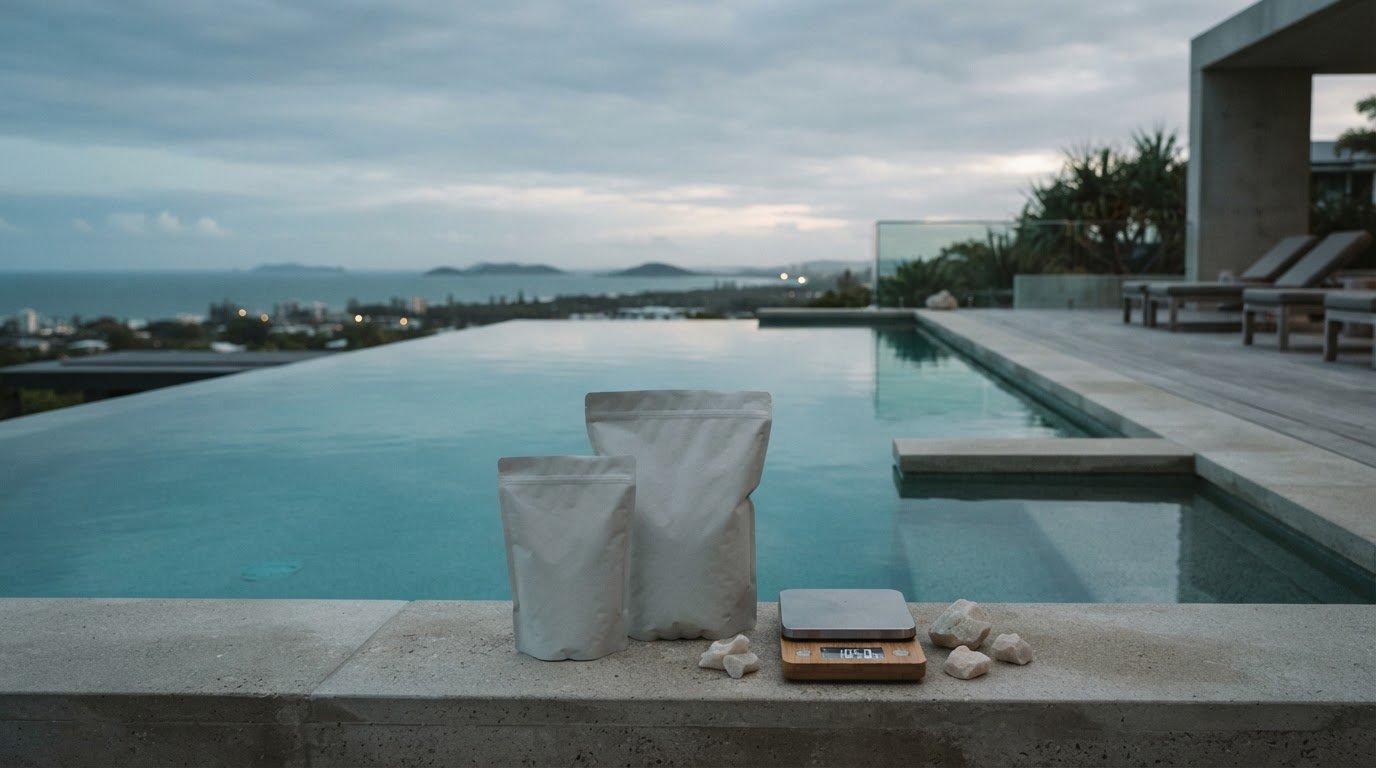
Magnexa’s magnesium pool minerals are available in 10 kg and 25 kg bags, and starter packs are designed for pool conversions. The right format depends on your pool and the product instructions.
Magnexa’s dosing calculator helps estimate the quantity required for your pool. Use it as a planning tool, not a universal dose: the quantity depends on pool volume and the selected product’s instructions. Follow those instructions when adding minerals and managing the water. The calculator supports quantity planning, while product guidance remains essential.
Before choosing a format, have your pool volume to hand and consider whether you’re adding minerals to an existing setup or planning a conversion. This connects the quantity question to your pool instead of relying on a general estimate. Starter packs are designed for conversions, while the 10 kg and 25 kg bags offer other formats for pool minerals.
A straightforward next step for local pool owners
Magnexa delivers pool minerals and salts across South East Queensland, including Brisbane, Moreton Bay, the Sunshine Coast, Ipswich, Logan and Redlands, and the Gold Coast. If you’re in one of these areas, you can choose a product format and use the dosing calculator to plan the quantity for your pool.
The practical decision still rests on your priorities: whether you want a different water experience, whether the pool setup and care requirements suit your household, and whether the product guidance fits your plans. There’s no need to treat mineral water as a wellness promise. Focus on the specific experience you want and the practical requirements of your pool, rather than medical claims or a one-size-fits-all quantity.
If mineral water fits your priorities, explore Magnexa’s magnesium pool minerals and use the dosing calculator to estimate the quantity for your pool.
Make your next pool-water decision with confidence
Before changing anything, write down what you want the pool to do differently. A clear goal makes it easier to judge whether a mineral option is relevant and assess the change on its own terms. Keep the decision practical: choose for the swimming experience and pool setup, not for a medical outcome the water cannot promise.
That gives you a straightforward way to assess magnesium pool benefits for your household. If the appeal is a different water experience, consider the product guidance and your pool’s requirements before deciding. There’s no need to rush or expect every swimmer to notice the same thing. A measured choice is more useful than a promise of results.
If you’re ready to explore the option, view Magnexa magnesium pool minerals and consider how they fit your pool and priorities. Take the next step when the practical details make sense for your household.
Frequently Asked Questions
Do magnesium pools have proven health benefits?
No established medical benefit follows simply from swimming in a magnesium pool. You may enjoy the swim or find the water comfortable, but that experience does not show that the minerals caused a health effect. Magnesium has recognised roles in the body, yet this does not establish that pool exposure provides a therapeutic dose. Treat claims about magnesium pool benefits as health claims only when they’re supported by reliable clinical evidence.
Can a magnesium pool replace chlorine?
No. Magnesium minerals and sanitation have separate roles. Minerals contribute to the pool’s water composition, but they do not sanitise the water on their own. A mineral pool still needs an appropriate sanitation system and routine care. Do not stop using chlorine or change your sanitation method simply because minerals have been added. Follow the instructions for your specific pool system and mineral product, including guidance on maintaining safe, properly treated water.
Does magnesium pool water contain magnesium?
Yes, if the pool has been treated with a product containing magnesium-bearing minerals. Once added and dissolved, those minerals form part of the pool water’s composition. The precise formulation can differ between products, so the term “magnesium pool” does not describe one identical mineral mix. Check the product information to understand what you’re adding. Do not assume that the water’s magnesium content indicates a health effect or a specific level of absorption.
Can you swim in a magnesium pool if you have sensitive skin?
Some people with sensitive skin may be comfortable swimming in mineral-treated water, while others may notice irritation. There’s no single response that applies to everyone, and the minerals do not guarantee that irritation will stop. If you have a diagnosed skin condition, persistent symptoms or a previous reaction to pool water, seek advice from a health professional about swimming. If a swim causes discomfort, leave the water and follow appropriate professional guidance.
Is magnesium pool water safe to drink?
No. Pool water isn’t drinking water and shouldn’t be consumed, whether it contains magnesium minerals or not. Pool water is managed for swimming, not prepared to drinking-water standards. Keep an eye on children around the pool and discourage them from swallowing the water. If someone drinks pool water and becomes unwell, seek advice from a health professional or an appropriate Australian health advice service.
Do magnesium pools feel different to swim in?
They can feel different to some swimmers, but the sensation is subjective rather than guaranteed. A swimmer might describe the water as silky, while another may notice no difference. Water temperature, its overall balance and the individual swimmer’s perception can all affect the experience. If you’re comparing pools, swim under similar conditions and treat your own preference as a practical observation, not evidence of a medical effect.
Are magnesium pools suitable for families with children?
A mineral pool can be considered for family swimming, but magnesium content does not make a pool safer for children or provide a proven health benefit. Children still need close, active supervision, and the pool needs suitable barriers, sanitation and routine care. Families in Brisbane, Moreton Bay, the Sunshine Coast, Ipswich, Logan and Redlands, or the Gold Coast should follow the pool safety requirements that apply where they live.
Frequently Asked Questions
More articles