Magnesium vs Chlorine Pool: What’s the Practical Difference?
15 October 2026 · 15 min read
A magnesium pool may still rely on chlorine for sanitation. That’s the key distinction in the magnesium vs chlorine pool question: minerals change the water’s composition, but they don’t automatically disinfect it. Depending on the setup, a compatible chlorinator may still produce chlorine to sanitise the water.
If you’re considering claims about softer-feeling water or easier care, separate the mineral system from the sanitation method. Your day-to-day routine still depends on the equipment, water balance and how the pool is used. Changing the mineral mix doesn’t remove the need to monitor water conditions.
This comparison explains how magnesium and chlorine systems treat pool water, what ongoing care involves, and what to consider before changing an existing pool. It also covers why equipment compatibility and the current setup matter. If magnesium minerals suit your pool, a dosing calculator can help estimate the amount needed.
Key Takeaways
- In a magnesium vs chlorine pool comparison, distinguish the minerals in the water from the method used to sanitise it.
- Compare ongoing care by looking at your current treatment system, water-care routine and equipment requirements.
- Before adding minerals to an existing pool, identify its setup and check the equipment and product guidance.
- Use your pool volume to estimate the mineral quantity rather than guessing.
- Magnexa offers magnesium pool minerals in 10 kg and 25 kg bags, starter packs and delivery across South East Queensland.
Magnesium vs chlorine pool: what does the difference actually mean?
Minerals describe what’s dissolved in pool water; chlorine is commonly used to sanitise it. These terms describe different things, so a magnesium pool can still use chlorine as part of its sanitation process. The choice isn’t always magnesium or chlorine. It may instead be whether to add magnesium minerals while keeping a sanitation system that uses chlorine.
A magnesium pool is pool water with a magnesium-containing mineral blend added; sanitation is a separate function. This distinction matters because mineral content alone doesn’t tell you how the water is sanitised. For a useful magnesium vs chlorine pool comparison, identify both the water’s mineral composition and the method used to control harmful microorganisms.
What people mean by a magnesium pool
A magnesium mineral pool has magnesium-containing minerals added to its water. These minerals affect the water’s composition, but they aren’t a complete sanitation method and don’t make the pool self-sanitising. Mineral blends and their use vary by product, so follow the label rather than assuming every product is dosed or used in the same way.
What people mean by a chlorine pool
A chlorine pool uses chlorine for sanitation. Chlorine helps control microorganisms in the water. It may be added directly or produced by a chlorinator, which generates chlorine from pool water. The term describes the sanitation approach, not whether the water contains dissolved minerals.
A pool can therefore contain minerals and still use chlorine. Adding magnesium minerals to an existing pool doesn’t, by itself, establish how that pool is sanitised. Its equipment and care instructions still matter. In some mineral systems, a compatible chlorinator continues to produce chlorine. The precise arrangement depends on the system in place.
Keep these two questions separate when comparing options:
- What’s in the water? This includes any magnesium-containing minerals added to it.
- How is it sanitised? This identifies whether chlorine or another sanitation method is being used.
Chlorine is one of several pool sanitation methods, not a synonym for a particular mineral profile. The overview of Swimming pool sanitation methods provides broader context on how different approaches are used. For your pool, use the product directions and equipment information to understand how mineral additions fit with its existing treatment setup.
How magnesium minerals and chlorine sanitation work together
A mineral addition and a sanitation system do different jobs. Minerals change what is dissolved in the water, while sanitation controls microorganisms that can make pool water unsafe. Adding magnesium minerals doesn’t, by itself, sanitise the water or remove the need to operate the pool’s existing treatment system.
Mineral content is not the same as sanitation
Think of these as two separate parts of pool care: one describes the water’s contents, and the other describes how it’s treated. Don’t treat magnesium minerals as a disinfectant unless the product instructions specifically support that use. Keep following the operating instructions for the pool’s sanitation system, even if you add minerals.
The phrase “magnesium pool” doesn’t identify a single sanitation arrangement. A pool might use a system that produces chlorine or another treatment method. The minerals alone don’t tell you which system is in place. Mineral content also can’t establish whether sanitation is operating correctly, whether the water is safe to swim in, or what treatment the pool needs.
Why equipment and water-care instructions matter
Compatibility depends on the pool equipment and the mineral product instructions. Different systems may have specific operating requirements, so don’t assume a product can be added in the same way to every pool. Before making a change, read the equipment guidance and product label, then follow their directions for testing and water care.
For example, if your pool uses a chlorinator, its settings and operating instructions still matter after adding minerals. If it uses another sanitation method, follow that system’s guidance instead. Don’t copy a chlorine target, mineral dose or equipment configuration from a general comparison and assume it suits your pool. Requirements can vary by product and setup.
Before adding minerals:
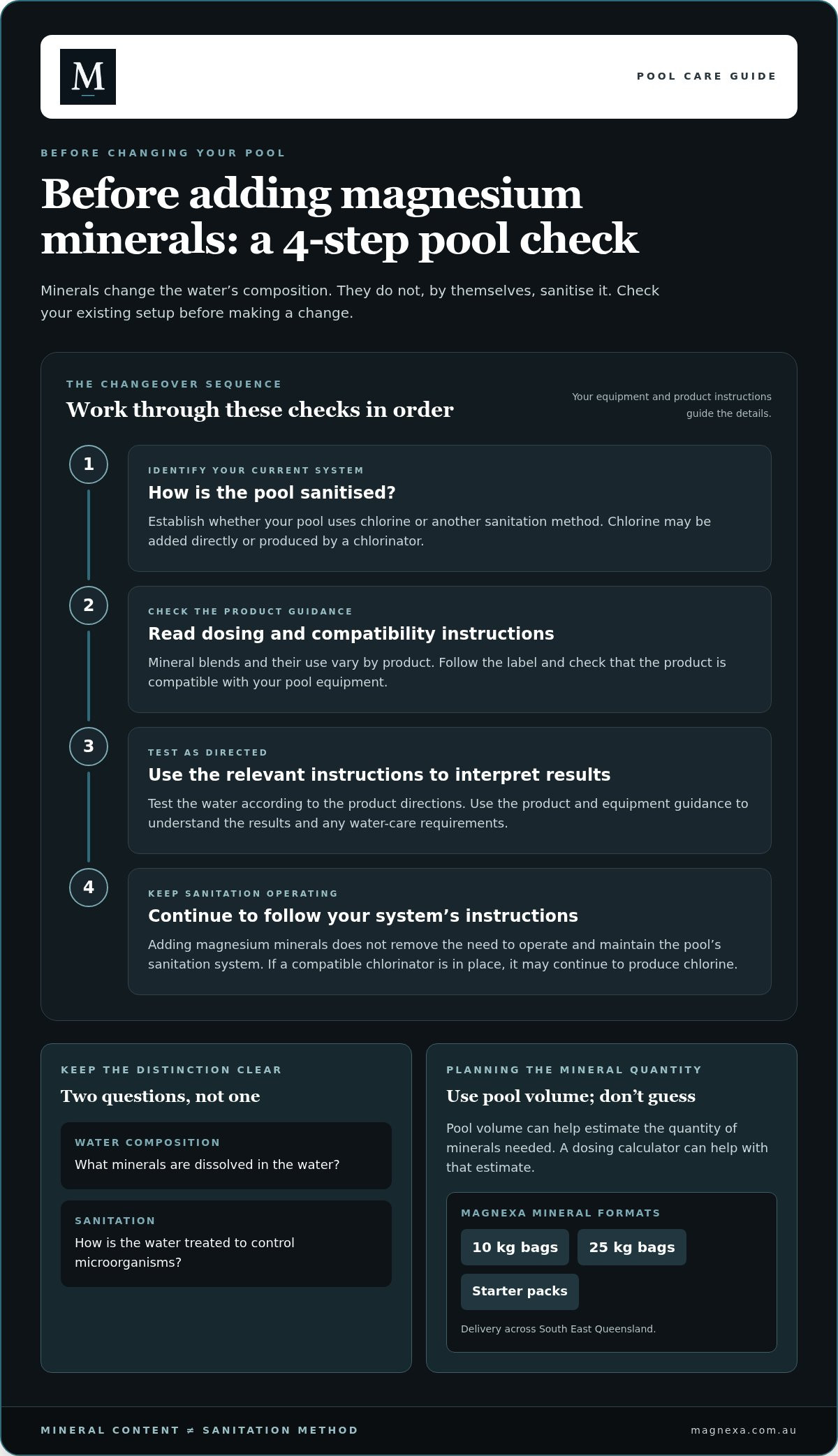
- Identify the sanitation method your pool currently uses.
- Read the mineral product instructions for dosing and compatibility.
- Test the water as directed, using the relevant product and equipment guidance to interpret the results.
- Continue operating and maintaining the sanitation system according to its instructions.
A useful magnesium vs chlorine pool comparison asks what minerals are present, then separately establishes how the water is sanitised and what the equipment requires. If magnesium minerals suit your pool’s setup, Magnexa’s magnesium pool minerals are available in 10 kg and 25 kg bags and starter packs. Magnexa’s dosing calculator can help estimate the quantity based on pool volume.
Magnesium vs chlorine pool: compare the practical differences
A practical comparison separates how the water is treated from how it feels to swim in. Magnesium minerals change the water’s composition; chlorine is a sanitation method. Neither label alone tells you the full care routine. That depends on the pool’s treatment system, equipment and product instructions.
| What to compare | Magnesium mineral pool | Pool sanitised with chlorine |
|---|---|---|
| Water composition | Magnesium-containing minerals are added to the water. The blend depends on the product. | Chlorine sanitation doesn’t specify whether minerals are present. Water composition depends on what else has been added. |
| Sanitation | Minerals don’t automatically sanitise the pool. A separate sanitation method is still required. | Chlorine is used to sanitise the water. How it is supplied depends on the pool’s setup. |
| Ongoing care | Water still needs testing and care according to the sanitation system and product directions. | Water also needs testing and care, following the chlorine product and equipment instructions. |
| Equipment checks | Check that the existing equipment and mineral product instructions are compatible. | Follow the operating guidance for the current sanitation equipment and products. |
| Conversion | Before adding minerals, assess the pool’s existing treatment setup and any equipment requirements. | Adding minerals changes the water’s composition, but doesn’t itself change the sanitation method. |
Water feel and swimmer preference
Some swimmers prefer the feel of one pool over another, but that response is personal. Don’t assume magnesium minerals will make water feel softer for everyone or prevent irritation. Water balance and pool care can also affect the swimming experience. When considering claims about potential benefits, consult a magnesium pool benefits guide and distinguish sourced evidence from individual preference.
Routine care and equipment considerations
Both setups require attention to water condition and correct sanitation. There isn’t one maintenance schedule or set of settings that applies to every pool. Follow the testing instructions for the products and treatment equipment you use. Before adding minerals, compare the product directions with the equipment guidance. Compatibility and water-care requirements depend on the existing setup.
The useful takeaway from a magnesium vs chlorine pool comparison isn’t that one option is always better. Compare the mineral composition, sanitation method, equipment needs and care instructions for your pool. Treat water feel as a preference to assess, not a guaranteed outcome. This gives you a more reliable basis for choosing than a broad claim about either system.
Which pool setup suits your household and existing system?
The right choice depends on your existing pool, the treatment equipment it uses and the care routine your household is prepared to follow. A preference for mineral water is worth considering, but it doesn’t remove practical requirements such as water testing or equipment compatibility. Use this sequence to make a decision based on the facts about your pool.
- Identify the current system. Check the pool documentation and note how it is sanitised, which products are used and how the equipment is operated. Don’t rely on a “chlorine” or “mineral” label alone to describe the whole setup.
- Compare the equipment and product guidance. Before adding minerals, review the pool equipment instructions alongside the mineral product directions. They explain whether the proposed change fits the existing setup and which water-care steps apply.
- Consider your care preferences. Decide whether your household is comfortable with its current routine or wants to explore mineral water. Either way, plan to follow the relevant testing and sanitation instructions.
Questions to answer before choosing
Start with information you can verify. Find the equipment manual, product labels and pool-care records. Establish the current sanitation approach and identify the equipment connected to it. Then decide what you want to change: the water’s mineral composition, the care routine, or both. These are separate decisions, and adding minerals doesn’t automatically change how the pool is sanitised.
Water feel is a personal preference, not a substitute for checking system requirements. If you’re interested in how mineral water may feel, consider that alongside the ongoing care your pool needs. Read the mineral product and equipment instructions before changing the water’s composition. Follow any stated conditions or limits rather than general advice intended for a different pool.
When a conversion guide is the next useful step
If you’re considering changing an existing pool, the process depends on its current equipment and treatment setup. A general comparison can help you decide whether to investigate further, but it can’t establish the right approach for every pool. Don’t assume that adding minerals is a complete conversion or that every existing system works in the same way.
Once you’ve identified your setup and decided to explore a change, a step-by-step mineral pool conversion guide can help you understand the process. Keep your pool documentation and product instructions in view as you assess the information, rather than treating a general conversion description as a promise for every system.
If magnesium minerals suit your pool and you’re ready to estimate the quantity, use Magnexa’s pool dosing calculator with your pool volume. It’s a practical next step after considering your system and care requirements.
Choosing magnesium minerals with Magnexa in South East Queensland
If you’ve decided magnesium minerals may suit your pool, work out the quantity and choose a purchase format. Keep the existing treatment setup in mind. Adding minerals changes the water’s composition; it doesn’t remove the need to follow the sanitation system’s instructions.
Work out the mineral quantity for your pool
Pool volume is a key input when estimating how much mineral product you need. Use your pool’s known volume and follow the product directions rather than choosing an amount by guesswork. Magnexa’s dosing calculator helps estimate the mineral quantity for your pool, providing a practical starting point before you choose bags or a starter pack.
The calculator helps with the quantity decision, but it doesn’t replace the product label or guidance for your pool equipment. Use those instructions when adding minerals and caring for the pool afterwards. This applies whether you’re changing an existing setup or adding minerals to a pool already suited to them.
Order for delivery across South East Queensland
Magnexa supplies magnesium pool minerals in 10 kg and 25 kg bags, as well as starter packs. These formats give you options once you’ve considered your pool volume and the product guidance. The right quantity depends on your pool, so use the dosing calculator rather than treating a bag size as a recommended dose.
Magnexa delivers across South East Queensland, including Brisbane, Moreton Bay, the Sunshine Coast, Ipswich, Logan, Redlands and the Gold Coast. This regional delivery service brings pool minerals and salts to customers across the area.
The magnesium vs chlorine pool comparison is most useful when it leads to a decision based on your own pool. First understand how the pool is sanitised and what its equipment instructions require. Then estimate the mineral quantity from pool volume and choose a purchasing format that suits your needs. Mineral additions and sanitation remain separate considerations.
If magnesium minerals suit your pool in Brisbane, Moreton Bay, the Sunshine Coast, Ipswich, Logan, Redlands or the Gold Coast, use the pool dosing calculator to estimate the quantity before choosing 10 kg or 25 kg bags or a starter pack. Follow the product directions when using the minerals, and continue to operate the pool’s sanitation system as instructed.
Make your next pool decision specific
Before changing your pool, decide what you want the change to achieve. Is your priority a different mineral composition, a particular water feel, or a care routine that better suits your household? Being clear about your goal makes the magnesium vs chlorine pool choice easier to assess against your current setup, rather than broad claims about either option.
When you’re ready to consider magnesium minerals, use your pool volume to estimate the quantity. Then follow the product directions and equipment guidance when planning a change. A measured approach helps you make a practical choice without assuming minerals replace sanitation or guarantee a particular swimming experience.
Use Magnexa’s dosing calculator to work out the mineral quantity for your pool. Start with your pool details, then choose the mineral quantity and product format that suit your needs.
Frequently Asked Questions
Is a magnesium pool chlorine-free?
No. A magnesium pool isn’t automatically chlorine-free. Magnesium minerals and chlorine treatment are separate parts of the pool setup, and the existing system may still use chlorine. Before making changes, check the pool equipment instructions and the mineral product label. Don’t stop or reduce sanitation based only on adding minerals. Continue testing and caring for the water as directed for the products and equipment you use.
Can a saltwater chlorinator be used with magnesium pool minerals?
It depends on the chlorinator and the mineral product. Check the equipment manual for guidance on mineral blends, then compare it with the product directions before adding anything. If you can’t identify the chlorinator model, look for its label or documentation first. Don’t assume that a chlorinator suitable for one pool or mineral blend will suit another. Keep following its sanitation instructions while assessing compatibility.
How often should I test a magnesium pool?
There isn’t one testing interval that suits every magnesium pool. Follow the directions for your sanitation system, testing products and mineral product. If you’ve added minerals, use the label’s instructions for any follow-up testing rather than relying on a routine intended for a different pool. Clear-looking water isn’t proof that it’s balanced or sanitised. Record test results so you can track changes over time.
What happens if I add too much magnesium to my pool?
The effect depends on the product, the amount added and the pool’s existing water condition. Don’t add more minerals or try to correct the water using a dose copied from another pool. Check the product label and test the water using suitable products. Magnexa’s dosing calculator can help estimate mineral quantities from your pool volume before you add minerals, reducing reliance on guesswork.
Can I swim while changing a pool to magnesium minerals?
Only swim when the pool’s product instructions and sanitation system guidance indicate the water is suitable. Don’t judge readiness by appearance or by how long the change seems to have taken. Follow any testing directions supplied for the products and equipment in use, and use a pool-specific conversion guide for steps that depend on your system. If the water doesn’t meet the stated requirements, wait before swimming.
Do magnesium minerals replace the salt in a saltwater pool?
Don’t assume magnesium minerals are a like-for-like replacement for the salt already in your pool. The right approach depends on the mineral product and the pool’s equipment. Check both sets of instructions before changing the water, and keep the sanitation system operating as directed. If you’re assessing quantities, use the pool’s volume in a dosing calculator and follow the product label for how to use the calculated amount.
Frequently Asked Questions
More articles