Magnesium Chloride Pool: What It Does and How It Works
17 October 2026 · 14 min read
Does adding magnesium chloride make pool water safe on its own? A magnesium chloride pool may feel different, but the mineral isn’t a sanitiser and doesn’t replace the process that controls germs. That distinction matters when you’re comparing magnesium minerals, pool salt and chlorine.
The products can be used together, but they do different jobs. Magnesium chloride adds minerals to the water. In some systems, a compatible chlorinator uses chloride in the water to produce chlorine, which does the sanitising. The right setup depends on the pool, its equipment and the product used.
This guide explains what magnesium chloride does, how it differs from common pool salt and what it won’t replace. It also covers equipment compatibility and the details that affect how much mineral you need. Once you know your pool volume and the product directions, Magnexa’s dosing calculator can help estimate a suitable quantity.
Key Takeaways
- A magnesium chloride pool contains added minerals, but the mineral itself doesn’t replace a sanitising process.
- Magnesium chloride, magnesium sulphate and sodium chloride are different compounds with different pool uses.
- Before adding minerals, check your pool volume, water balance and equipment instructions for compatibility.
- The amount needed depends on your pool volume and the product’s directions.
- Magnexa supplies 10 kg and 25 kg mineral bags and conversion starter packs, with delivery across South East Queensland.
What does magnesium chloride mean in a pool?
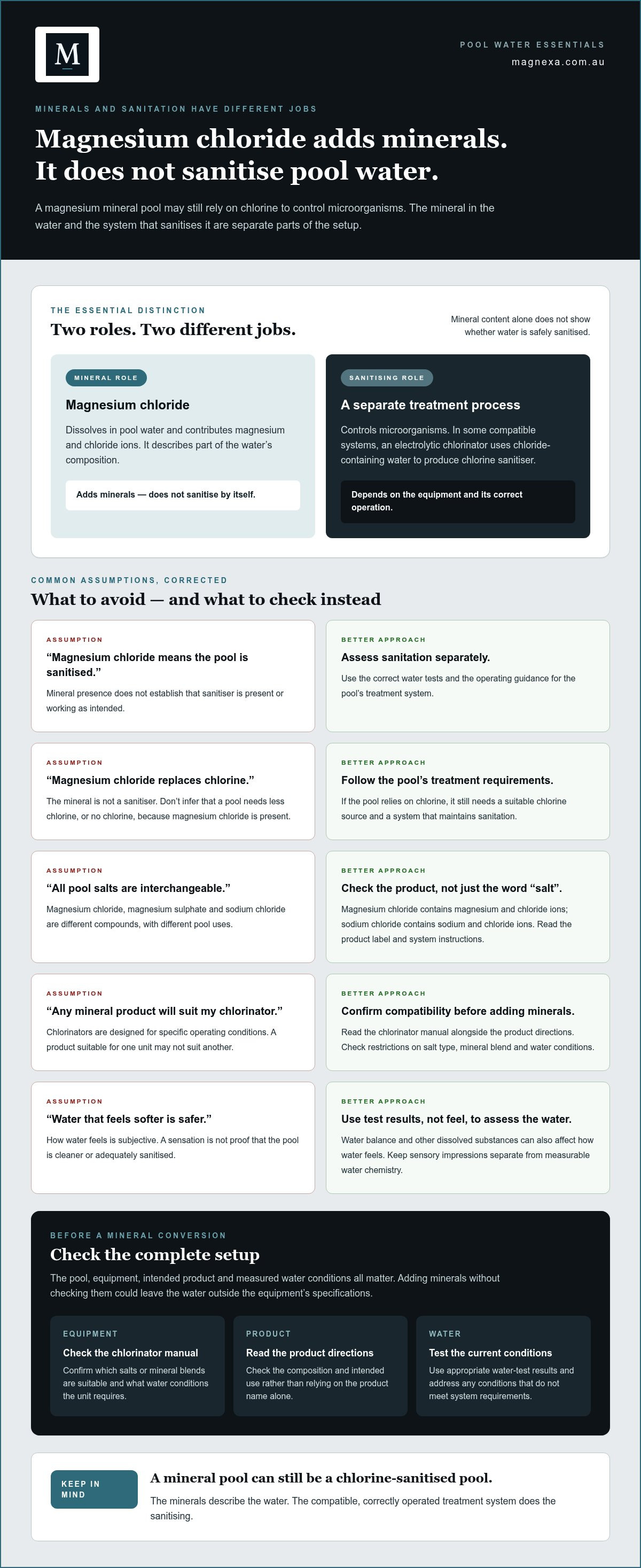
Magnesium chloride is a mineral salt that dissolves in pool water into magnesium and chloride ions. It doesn’t sanitise the pool by itself. The mineral describes part of the water’s composition; sanitation depends on a separate treatment process.
A magnesium chloride pool is a pool with magnesium minerals in its water. The label describes a mineral-water setup, not a guarantee that the water is chlorine-free. A pool can contain magnesium chloride and still rely on a chlorine-based system to control microorganisms. The equipment and treatment method determine how sanitation works, not the presence of magnesium alone.
Is magnesium chloride the same as ordinary pool salt?
No. Magnesium chloride and ordinary pool salt, sodium chloride, are different chemical compounds. Magnesium chloride contains magnesium and chloride ions, while sodium chloride contains sodium and chloride ions. Sharing chloride doesn’t make the compounds interchangeable or mean they behave identically in pool water.
This matters when choosing a product or interpreting your pool’s setup. The word “salt” can refer to different compounds, so check the product label and your system’s instructions rather than relying on the name alone. The key comparison is the product’s composition and intended use, not which salt is supposedly better.
What does the mineral do in pool water?
Once dissolved, magnesium chloride contributes magnesium and chloride ions to the water. That describes its chemistry, not a sanitising benefit. Its presence doesn’t show whether the pool has adequate sanitation, so it shouldn’t be treated as a substitute for the sanitiser or treatment system specified for the pool.
Descriptions such as “softer-feeling water” are subjective. Swimmers may notice the water differently, but that sensation isn’t proof that the pool is cleaner or safer. Water balance, other dissolved substances and individual perception can all affect how water feels. Keep those sensory descriptions separate from measurable water chemistry.
Magnesium chloride is a chemical compound with uses beyond pools, so its name alone doesn’t explain how a particular pool system treats its water. For more background on magnesium pool salts and pool-owner terminology, see Magnesium Pool Salt: A Straightforward Guide for Pool Owners. The essential distinction is simple: the mineral is an ingredient in the water; sanitation is a separate job.
How magnesium chloride fits into pool sanitation
Minerals and sanitation have different roles. Magnesium chloride contributes dissolved minerals to the water, while a separate treatment process controls microorganisms. In some pools, a compatible electrolytic chlorinator uses chloride in the water to produce chlorine sanitiser. Whether that process suits a magnesium-based setup depends on the chlorinator’s design and the pool product being used.
Mineral content alone does not establish that pool water is safely sanitised. A mineral reading can’t tell you whether the sanitiser is present and working as intended. Assess that using the correct water tests and the operating guidance for the pool’s treatment system.
Does magnesium chloride replace chlorine?
No. Don’t assume magnesium chloride replaces the pool’s required sanitising process. The mineral is not, by itself, a reliable basis for claiming that pathogens are controlled. If a pool relies on chlorine, it still needs a suitable source of chlorine and an operating system that maintains sanitation.
Some mineral-pool setups use an electrolytic chlorinator. In broad terms, the system applies an electrical current to chloride-containing water and generates chlorine sanitiser. The chemistry and permitted water composition depend on the equipment. A pool using magnesium minerals may still be a chlorine-sanitised pool, even if it’s described as a magnesium or mineral pool.
Sanitation depends on ongoing operation, not just what was added at the start. Follow the system instructions for testing and adjustment, and use current water-test results when making decisions. Don’t infer that a pool needs less chlorine, or no chlorine, simply because magnesium chloride is present.
Why the pool system matters
Chlorinators are designed for specific operating conditions. The manufacturer’s instructions set out which salts or mineral blends are suitable and what water conditions the unit requires. A product that works with one chlorinator may not suit another, so don’t assume one setup fits every pool.
Before adding magnesium minerals, read the chlorinator manual alongside the product directions. Check any stated restrictions on salt type or water chemistry, then test the pool water using the appropriate method. If the results don’t meet the system’s operating requirements, address that before changing the mineral content.
This is particularly important when converting an existing pool. The current chlorinator, intended mineral product and measured water conditions all inform whether the combination is suitable. Adding minerals without checking these details could leave the water outside the equipment’s specifications. A magnesium chloride pool is defined by its minerals, but its sanitation still depends on a compatible, correctly operated treatment system.
For pool owners planning a mineral conversion, Magnexa’s magnesium pool minerals and starter packs provide a practical starting point for product selection. Match the product to your equipment instructions and water-test results before use.
Magnesium chloride, magnesium sulphate and other pool minerals
Pool products described as salts or minerals can contain different compounds. The name matters because each compound contributes different ions to the water, and a pool system may be designed for a particular product or blend. This table summarises the basic chemical distinctions. It isn’t a ranking or a dosing guide.
| Compound | What it contains | Typical pool context |
|---|---|---|
| Magnesium chloride | Magnesium and chloride ions | Used in some mineral-pool products and blends |
| Magnesium sulphate | Magnesium and sulphate ions | A different magnesium compound; use depends on the product and pool system |
| Sodium chloride | Sodium and chloride ions | Commonly used as pool salt in saltwater chlorination systems |
Magnesium chloride and magnesium sulphate are different compounds
Magnesium chloride contains magnesium and chloride ions. Magnesium sulphate contains magnesium and sulphate ions. Both contain magnesium, but they aren’t the same salt and shouldn’t be treated as direct substitutes.
The product name alone may not describe every ingredient. A pool mineral product can be a blend, and formulations may vary. A magnesium chloride pool refers to the intended mineral setup, not a rule that every product labelled “magnesium” has the same composition or use. For a closer compound-by-compound discussion, see Magnesium Chloride vs Magnesium Sulphate Pools.
Why product labels and pool systems matter
Start with the composition and directions on the product label. The compound, other ingredients and intended use affect how the product should be added. A bag’s weight tells you how much product it contains, but it doesn’t establish that it supplies the same minerals as another bag of equal weight.
Check the pool system’s instructions, too. A chlorinator or other treatment setup may specify which salt or mineral products it can use. Don’t assume magnesium sulphate can replace magnesium chloride, or either can replace sodium chloride, based on the word “salt” or the package weight.
For example, if a product label names a mineral blend, follow its directions rather than borrowing a dose from instructions for a single compound. When comparing products, look at the stated composition and intended pool use, then match those details to the equipment manufacturer’s guidance. This gives you a useful comparison without assuming one compound is suitable for every pool.
What to check before using magnesium chloride in your pool
Before adding a mineral, check that the quantity, water condition and equipment suit the product. Pool size alone isn’t enough to work out a dose: you also need the product’s directions and your pool’s volume. Using those details is more reliable than estimating or copying another pool owner’s dose.
- Confirm the pool volume. Use the pool’s recorded capacity or calculate it from its dimensions and shape. If the volume is only an estimate, the amount of mineral you calculate will be an estimate too. For an irregular pool, check how its volume was worked out before planning a conversion.
- Test the water. Get current readings before changing the mineral level. Compare them with the product directions and the requirements for your pool system. Don’t rely on old results if the water has since been topped up or treated.
- Review system compatibility. Read the chlorinator and other relevant equipment instructions. Check whether they specify acceptable mineral or salt types and operating conditions. Compatibility varies between systems, so don’t assume a product suited to one pool will suit another.
- Follow the product directions. Use the instructions for the exact product you have. Don’t substitute a dose from another mineral or calculate by bag weight alone. When converting an existing pool, follow a process that accounts for your current water and equipment.
Check water condition and pool equipment
Current test results give you a starting point before changing the water’s mineral content. Compare them with the product directions and equipment requirements instead of assuming every pool surface or chlorinator is compatible. If the equipment manual sets limits or conditions, use those to guide your decision.
A conversion involves more than adding a bag of minerals. The existing treatment system and water condition affect the steps involved. The article Mineral Pool Conversion: Step-by-Step Guide covers that process in more detail.
Work out quantity without guessing
The amount needed depends on the pool’s volume and the product’s stated target mineral level. A larger pool generally needs a different amount from a smaller one, but there’s no universal dose for every product and setup. Follow the directions for your product, and don’t transfer a quantity intended for a different compound or blend.
Once you have the pool volume and product details, Magnexa’s Magnesium Pool Dosing Calculator can help estimate the quantity. Use it as a planning tool alongside the product directions, not as a replacement for them. To estimate what your pool needs, use Magnexa’s pool dosing calculator.
Getting magnesium pool minerals in South East Queensland
Once you’ve identified the mineral and checked it against your pool system, choose a product format and estimate the quantity. The product label should match the intended use: the word “mineral” alone doesn’t tell you the composition or whether it suits your equipment. Keep the product directions and pool details together as you plan.
Choose a format around the job
Magnexa supplies magnesium pool minerals in 10 kg and 25 kg bags. These are available formats, not different formulas or recommendations for particular pool sizes. Choose based on the quantity indicated by the product directions and your pool-volume estimate, rather than assuming a larger bag is automatically the right choice.
For a mineral-pool conversion, Magnexa also supplies starter packs designed for conversions. Read the pack information and product directions to understand its intended use, then match the mineral product to your pool and equipment. The format helps with product selection, but it doesn’t replace the checks needed before adding minerals.
This applies whether you’re setting up a magnesium chloride pool or comparing mineral options. Confirm the compound and intended use on the label before purchasing. Magnesium chloride and magnesium sulphate are distinct compounds, so don’t use instructions for one as directions for the other. Choose a product that matches your intended mineral setup and pool-system requirements.
Use pool volume to plan the next step
Quantity depends on the pool’s volume and the mineral level specified for the product. Have the volume available before estimating how much you need. Magnexa’s dosing calculator can help estimate a quantity based on pool volume. Use the estimate alongside the product directions, not as a reason to skip them.
Magnexa delivers pool minerals and salts across South East Queensland, including Brisbane, Moreton Bay, the Sunshine Coast, Ipswich, Logan and Redlands, and the Gold Coast. Local pool owners can choose from mineral bags or conversion starter packs, with product selection guided by their pool’s requirements.
To compare formats and plan an estimated quantity, explore Magnexa’s pool mineral options. Check the product directions and equipment guidance before adding minerals so your next step is based on your pool, not a generic dose.
Make your next pool decision with clear information
Before choosing a product, write down what you want to change: the mineral content, the pool’s treatment setup, or both. Keep the product label, pool volume and latest water-test results together. These details make it easier to check whether a product suits your system and follow its directions.
A magnesium chloride pool is a choice about the water’s mineral composition, not a shortcut around the established sanitation process. Keep those decisions separate. If you’re considering a change, take it one step at a time and use the equipment manufacturer’s guidance alongside the product instructions.
When you’re ready to compare products, explore Magnexa magnesium pool minerals. Use the product directions and your pool details to plan a suitable next step.
Frequently Asked Questions
Can magnesium chloride be used in any swimming pool?
No, not automatically. Compatibility depends on the pool equipment, product directions and current water condition. A chlorinator manual may specify which mineral or salt types it supports. Compare that guidance with the product label and recent water-test results before adding anything. Don’t assume a product suits your setup just because it has worked in another pool.
How much magnesium chloride should I add to my pool?
There isn’t one amount that suits every pool. The quantity depends on the pool’s volume, the product directions and the intended mineral level. A recorded pool volume gives you a more useful estimate than a visual guess. Use Magnexa’s dosing calculator to estimate the quantity, then follow the directions for the specific product you plan to use.
Can I add magnesium chloride directly to the pool?
Follow the specific product label and your pool-system instructions for handling and adding magnesium chloride. Products can differ, so don’t assume a method used for another mineral or brand applies to yours. Check whether the directions specify how to add it and any equipment settings or precautions. When converting a pool, follow the conversion instructions for your chosen product rather than improvising.
Will rain dilute magnesium chloride in a pool?
Rain can add water to a pool and affect its volume and water balance. The practical effect depends on rainfall, overflow, splash-out and any water added later. Don’t assume a fixed amount of magnesium chloride needs replacing after rain. Test the water and compare the results with the product and equipment guidance. If water has overflowed, test again before making an adjustment.
Can magnesium chloride affect pool equipment?
Whether a mineral product is suitable depends on equipment design, water chemistry and product composition. Check the chlorinator and other relevant equipment specifications before use, then monitor water balance according to the system instructions. Pool owners in Brisbane, Moreton Bay, the Sunshine Coast, Ipswich, Logan and Redlands, and the Gold Coast should follow the guidance for their own equipment and water rather than rely on a general assumption.
Is magnesium chloride the same as Epsom salt?
No. Magnesium chloride and Epsom salt, commonly magnesium sulphate, are different compounds. Both contain magnesium, but their other components differ, so they aren’t interchangeable pool products. Don’t substitute one for the other by matching bag weight: equal weights don’t establish equal composition or suitability. Check the pool product label and system instructions, and use a product intended for the mineral setup you’re working with.
Frequently Asked Questions
More articles