How Much Mineral Salt Should You Add to a 50,000 L Pool?
16 October 2026 · 16 min read
Pool volume alone isn’t enough to calculate a dose. If you’re asking how much mineral salt to add to 50000L pool, the answer also depends on the product’s target concentration and the minerals already in your water.
It’s sensible to want a clear amount before opening a bag. But mineral salt and conventional pool salt don’t always use the same dose, and a quantity calculated for one mineral product may not suit another. The current water reading matters too: if minerals are already present, you may need less than you would for a new fill.
This guide explains which details you need, walks through an illustrative calculation for a 50,000 L pool, and shows how Magnexa’s Dosing Calculator can help you plan a quantity. You’ll also learn how to compare the calculated amount with Magnexa’s 10 kg and 25 kg bags and starter packs.
Key Takeaways
- Pool volume alone can’t determine how much mineral salt to add to 50000L pool. Use the selected product’s target and your current water reading.
- Use a calculation as an estimate, then follow the mineral product’s instructions for the intended dose.
- Check the product label and pool equipment instructions before adding minerals. Add in stages only if the directions allow it.
- Use Magnexa’s Dosing Calculator to plan a quantity for your pool volume.
- Once you have a calculated amount, compare it with the available 10 kg and 25 kg bags and starter packs.
How much mineral salt does a 50,000 L pool need? Start with the product
Pool volume alone can’t tell you a safe, product-appropriate mineral quantity. The answer to how much mineral salt to add to 50000L pool depends on the product’s formulation, its stated target and the concentration already in the water. A dose intended for one mineral blend may not suit another.
Magnesium pool minerals aren’t interchangeable with conventional pool salt. Conventional pool salt is generally sodium chloride, used by a saltwater chlorinator to produce chlorine. Magnesium products have their own formulations and dosing instructions. Adding minerals doesn’t replace the pool’s required sanitising system, so keep the sanitiser operating as directed for your pool and equipment.
Why one mineral dose does not fit every pool
Mineral products can have different compositions and target concentrations. A product designed to establish a mineral pool may call for a different amount from one intended to supplement water that already contains salt or minerals. The pool’s 50,000 L capacity is only one part of the calculation.
Use the instructions for the exact product you’re adding, including its stated target and any guidance for your pool setup. Don’t take a conventional chlorinator’s salt requirement and apply it to magnesium minerals. Salt water chlorination describes how a chlorinator uses salt to produce chlorine, but its salt levels aren’t a dosing guide for every mineral product.
Check the product label alongside the pool equipment manufacturer’s instructions before deciding on a quantity. If the directions specify a target concentration, use that target rather than borrowing a figure from another product or a general saltwater-pool guide.
New mineral setup or topping up an existing pool?
An initial conversion and a top-up are different dosing situations. For a new mineral setup, the product instructions may give an initial dose to reach the intended starting concentration. For an existing pool, some minerals may already be present, so adding the full initial quantity could take the water beyond the product’s target.
That’s why a current, reliable water reading matters. Establish the existing concentration before calculating an addition, and interpret the test result in line with the product’s directions. If the pool has previously used conventional salt, don’t assume its reading represents the amount of magnesium minerals present. The product formulation determines what the reading means for its dose.
For background on how magnesium pool salt differs from conventional pool salt and how it’s used, see the straightforward guide to magnesium pool salt. The next step is to identify the product target and current reading, then calculate only the amount needed to bridge the difference.
What changes the mineral quantity in a 50,000 L pool?
A 50,000 L pool gives you a starting point, not a complete dose. The quantity depends on the mineral product’s target concentration and the pool’s current reading. If either value is wrong or missing, the calculated amount can be misleading. Use the product instructions and a reliable water test rather than relying on a generic salt table.
Check the product target and current mineral level
Use the target and dosing directions for the exact product you’re adding. A test result shows how far the water is from that target. The difference matters: a pool already at or near its intended level may need little or no addition, while a new setup may require a different starting dose. Don’t substitute a conventional salt target for a magnesium mineral product’s instructions.
Take a reading before adding minerals, using a testing method suited to the product and the measurement its instructions require. Record the result and target in the same units. If you don’t have a reliable reading or product target, avoid guessing. Magnexa’s Dosing Calculator helps you plan a quantity for your pool volume, providing a practical starting point before you decide what to order.
Consider pool volume, water changes and equipment
Pool volume estimates can be off, particularly if the shape is irregular or the dimensions are approximate. Because the calculation uses volume, an inaccurate estimate affects the result. Use the best available volume information and treat it as an estimate, not a laboratory measurement.
Water changes affect what remains in the pool. A partial drain followed by a refill can lower the concentration of minerals in the water. Overflow may also remove treated pool water, and the composition of refill water can differ. After a substantial water change, take a fresh reading rather than assuming the previous result still applies. A top-up after water loss may not call for the same quantity as an initial conversion.
Keep mineral concentration separate from chlorine production. A mineral reading describes the minerals in the water; it doesn’t establish that the pool is sanitised. A salt chlorinator has its own operating requirements, and adding minerals doesn’t replace the pool’s sanitising system. Follow both the mineral product directions and equipment manufacturer’s instructions. The Pentair Pool Salinity Calculator can provide context for conventional pool salinity calculations, but it isn’t a substitute for magnesium product dosing directions.
Before working out how much mineral salt to add to 50000L pool, confirm four things: the product target, the current reading, the pool’s estimated volume and whether water has recently been replaced or lost. Use Magnexa’s pool dosing calculator to plan a quantity for your pool volume.
How to calculate mineral salt for a 50,000 L pool
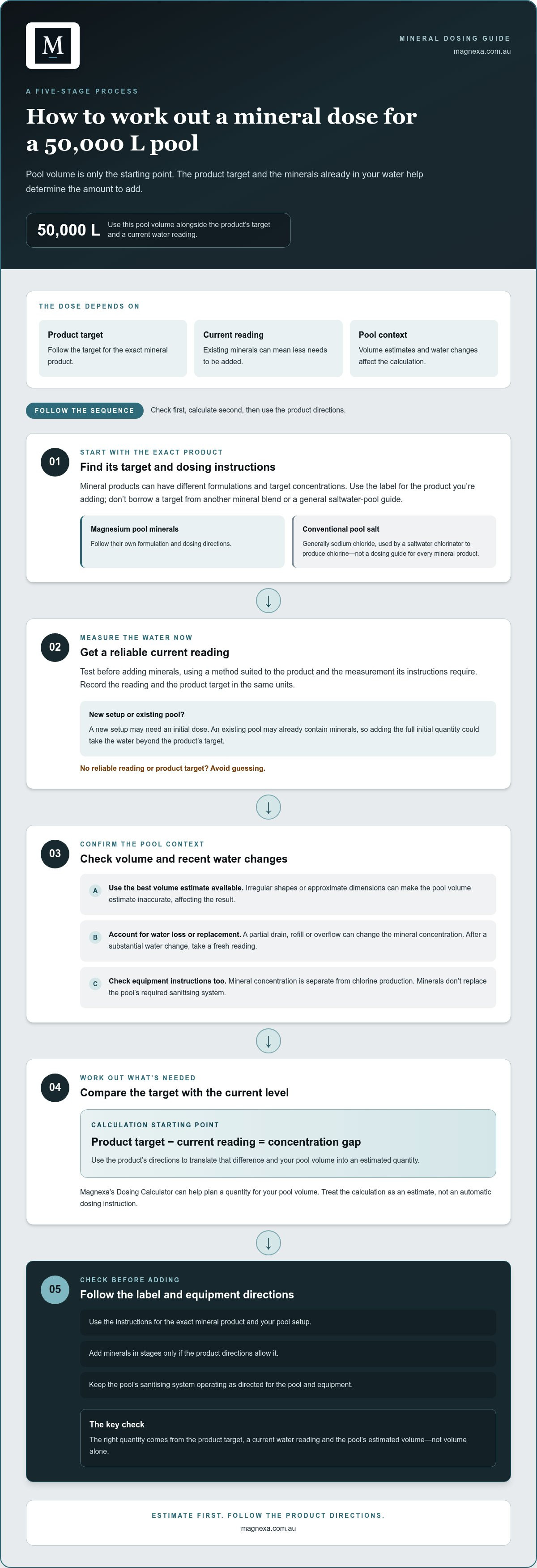
A useful calculation starts with the difference between the product’s target concentration and the pool’s measured starting level. It gives an estimate, not an automatic dosing instruction. Use the target and directions for the specific mineral product, because formulations can differ and the product instructions take precedence over a general calculation.
Work out the concentration gap before calculating
Subtract the current concentration from the product’s stated target. Keep both readings in the same units. For dilute pool water, 1 part per million (ppm) is approximately 1 milligram per litre (mg/L), so a target and test result both given in ppm can be compared directly.
For example, if a product target is 500 mg/L and the current reading is 400 mg/L, the concentration increase is 100 mg/L. These figures demonstrate the subtraction only. They are not a recommended target for a Magnexa product or any other mineral salt. If either the applicable target or starting reading is unknown, don’t calculate or guess a dose. Use the product directions or Magnexa’s Dosing Calculator to plan the quantity.
Apply the formula to 50,000 L
The calculation is:
Kilograms required = pool litres × concentration increase in mg/L ÷ 1,000,000
For a 50,000 L pool with an illustrative concentration increase of 100 mg/L:
50,000 × 100 ÷ 1,000,000 = 5 kg
This 5 kg result is arithmetic only. It is not a recommended mineral dose. The example doesn’t set a product target, account for a particular formulation or replace its dosing directions. The calculated mass is useful for planning only when the selected product’s instructions make that target and calculation appropriate.
The formula scales with the concentration gap. For the same 50,000 L volume, a 200 mg/L increase would produce a mathematical result twice as large as a 100 mg/L increase. A smaller gap produces a smaller estimate. This shows why a current test result matters, but it doesn’t make one product’s target suitable for another.
Before using the result, check that the pool volume is a reasonable estimate and that the concentration units match. Then compare the calculation with the exact product instructions. If the label gives a product-specific dose by pool volume, follow that direction rather than treating the formula as a substitute. The mass of a blended mineral product may not correspond directly to the concentration of one individual mineral in the water.
For a quantity tailored to your pool, use Magnexa’s pool mineral dosing calculator. It can help you plan a quantity based on your pool volume.
How to add minerals and check the pool afterwards
Once you’ve worked out a product-appropriate quantity, follow the instructions for adding it. Mineral products can differ in how they’re handled, applied and dissolved, so don’t assume that a method used for another product will suit yours. The label and your pool equipment manufacturer’s instructions are the reference points.
Prepare before adding the mineral product
Before opening a bag, confirm the pool’s estimated volume, the current water reading and the target stated for the exact product. Check the label for handling directions, where and how to apply the minerals, and any equipment compatibility instructions. Keep the pool’s required sanitising routine operating according to its own instructions. Mineral addition is not a replacement for sanitising.
Measure the amount rather than estimating by eye. If the label permits a staged addition, divide the calculated quantity only as directed. Staging isn’t a universal rule: if the product specifies another method, follow it. Don’t choose an application location or change equipment settings based on advice for a different mineral blend.
Before dosing, make sure the quantity still reflects the pool’s present condition. A recent refill or water loss can change the starting reading. If the reading or product target is uncertain, pause rather than adding extra on a guess. Checking those details is more useful than treating a calculation as an exact instruction.
Recheck the water before making another adjustment
After adding the minerals, allow the product the time specified on its label to dissolve or circulate before testing again. There’s no single circulation period that applies to every product and pool setup. Follow the equipment instructions too, then measure the relevant water level using a method suited to the product directions.
Compare the new reading with the product target before considering another addition. Don’t add more simply because some product is still visible or the water looks different immediately after dosing. If residue remains or the water’s appearance changes unusually, consult the product guidance before taking another step.
Keep a simple record of the amount added, the date and the water reading before and after. This gives you a clearer starting point if you need to assess the pool again, particularly after a later refill or other water loss. It also helps distinguish a measured adjustment from an uncertain repeat dose.
For anyone calculating how much mineral salt to add to 50000L pool, the dose is only one part of the process. Accurate inputs, product-specific application directions and a follow-up reading help keep the addition controlled. Use Magnexa’s dosing calculator to plan a quantity for your pool volume.
Plan a 50,000 L dose with Magnexa’s calculator and mineral options
Turn the calculation into a plan using the details that determine the dose, not pool volume alone. Confirm the pool’s estimated volume, test the current mineral level, identify the selected product’s target and use its instructions to calculate the amount. This gives you a product-specific quantity to plan around, rather than a generic kilogram figure.
Turn the calculated quantity into a practical order plan
Use the calculator result alongside the product directions. Magnexa’s Dosing Calculator helps you work out mineral quantities for your pool volume. Once you have a calculated amount, compare it with the available formats: pool minerals in 10 kg and 25 kg bags, as well as starter packs. These formats help you plan what to order, but the bag size itself doesn’t establish the dose.
Start with the quantity your pool needs, then consider how the available formats fit. Don’t assume a particular combination of bags will match the calculated amount exactly, or buy extra to compensate for uncertain readings. If you’re converting from a conventional salt pool, account for the pool’s existing water reading and follow the mineral product’s conversion instructions. The mineral pool conversion step-by-step guide can help you understand the broader process.
Before placing an order, keep your pool volume, test result, product target and calculated amount together. That record makes it easier to check that the planned quantity still reflects your pool, particularly if water has been replaced since testing.
Use the local supply option when you are ready
Magnexa supplies magnesium pool minerals and starter packs, with delivery across South East Queensland. The service area includes Brisbane, Moreton Bay, the Sunshine Coast, Ipswich, Logan, Redlands and the Gold Coast. If your pool is in one of these areas, you can plan a mineral addition using the product instructions and your pool volume, then choose the format that suits your order.
If you’re still working out how much mineral salt to add to 50000L pool, start with the product’s target and your pool’s measured level. Use the calculator to plan the quantity before choosing a bag format. Use Magnexa’s dosing calculator to plan your pool mineral quantity.
Make your next mineral addition a measured decision
The useful answer to how much mineral salt to add to 50000L pool isn’t a fixed number of kilograms. It’s a quantity based on the pool’s actual condition and the instructions for the product you’ve chosen. That distinction helps you avoid treating a calculation example as a dose recommendation.
Before you act, make sure you can trace the planned amount back to its inputs. If the product target, water reading or pool volume changes, revisit the calculation. Keep your decision tied to those details rather than carrying a previous dose forward automatically.
Magnexa’s Dosing Calculator is a practical next step for planning a pool-specific quantity. Use Magnexa’s dosing calculator to plan your pool mineral quantity, then follow the product instructions when adding it. A measured approach gives you a clearer basis for managing your pool.
Frequently Asked Questions
Can I use a standard pool salt dosage table for magnesium minerals?
No. A standard pool salt table usually relates to sodium chloride and a chlorinator’s salt requirement, so it isn’t a reliable dose guide for magnesium minerals. To work out how much mineral salt to add to 50000L pool, use the exact mineral product’s directions and target. For example, don’t use a chlorinator’s salt top-up figure to decide how many bags of magnesium product to add.
How many kilograms does a 100 ppm increase need in a 50,000 L pool?
Mathematically, a 100 mg/L increase in 50,000 L represents 5 kg of dissolved material. This illustrates the calculation only, not a recommended mineral dose. The required quantity depends on the selected product and the pool’s starting reading. If your test result is given in ppm, treat it as approximately equivalent to mg/L for this calculation, then follow the product’s own instructions.
Should I add the full calculated mineral amount at once?
Only if the product directions say to apply the full quantity at once. Don’t assume one application method suits every mineral product or pool system. First check that the measured starting level and intended target are correct. After adding the product as directed, wait for the label-specified dissolution or circulation period before retesting. Use the new reading to decide whether another adjustment is needed.
What happens if I add too much mineral salt to my pool?
The effect depends on the mineral formulation, the amount added and the pool equipment. If a reading is higher than intended, don’t try to counter it by adding other chemicals or more minerals without product-specific guidance. Retest using the method specified for the product, review its instructions and follow the equipment manufacturer’s advice. Keep the amount added and test results recorded to support your next decision.
Do I need to drain a 50,000 L pool before adding mineral salt?
No, adding minerals doesn’t automatically mean you need to drain the pool. The right approach depends on whether you’re converting, topping up or adjusting an existing mineral setup. For example, a pool that already contains minerals may need a different addition from one being converted. Check the current water reading and the selected product’s conversion instructions before deciding whether any water needs replacing.
Can I add magnesium minerals if my pool already has salt?
Possibly, but don’t assume the existing salt level tells you how much magnesium product to add. Identify what has been added to the pool and use a current reading relevant to the mineral product. Then check the product’s compatibility guidance and target. An unknown starting level makes a full conversion quantity a poor assumption, so use product-specific instructions or a tailored dosing tool first.
How often should I top up mineral salt in a pool?
There isn’t one top-up schedule that suits every pool. Check the water after events that may remove or dilute pool water, such as backwashing, splash-out, overflow or a refill, then compare the result with the product target. Pool owners in Brisbane, Moreton Bay, the Sunshine Coast, Ipswich, Logan, Redlands and the Gold Coast can use readings rather than a calendar interval to guide the next dose.
Frequently Asked Questions
More articles