Redlands Coast pool salt delivery for magnesium pools
30 October 2026 · 5 min read
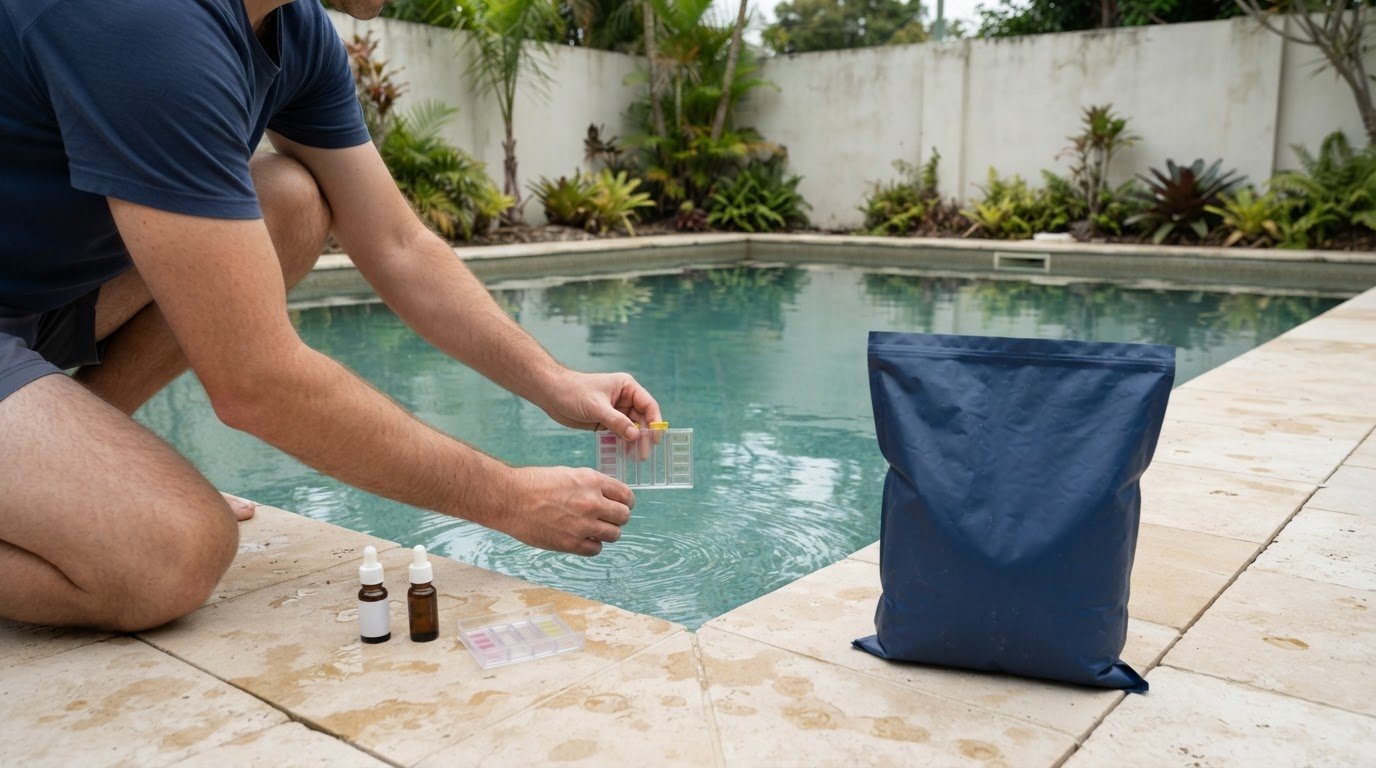
Pool salt delivery starts with a water test, not a bag count. For Redlands Coast pool salt delivery, a typical saltwater pool level is 3,000 to 4,000 PPM, while many chlorinators are designed to operate around 3,500 PPM. The amount to add depends on the pool’s volume and its current salt reading.
A low reading can trigger a chlorinator warning at around 2,500 PPM. Levels above 4,500 PPM can cause error codes, increase cell wear and make the water taste unpleasantly salty. Testing before adding salt helps avoid topping up by guesswork.
This guide explains how to calculate a pool salt top-up, arrange delivery and add salt so it circulates through the pool. It also covers magnesium pool minerals, how they differ from standard pool salt and what to consider when choosing between them.
Key Takeaways
- Use your pool’s water volume and current salt reading to work out the top-up, rather than estimating from the pool’s size alone.
- Spread salt across the shallow end with the pump running. Keep it out of the skimmer and away from the chlorinator cell.
- Allow the water to circulate before retesting so the salt can mix through the pool.
- For a mineral pool, compare the magnesium option in 10 kg and 25 kg bags with your pool’s needs.
Redlands Coast pool salt delivery
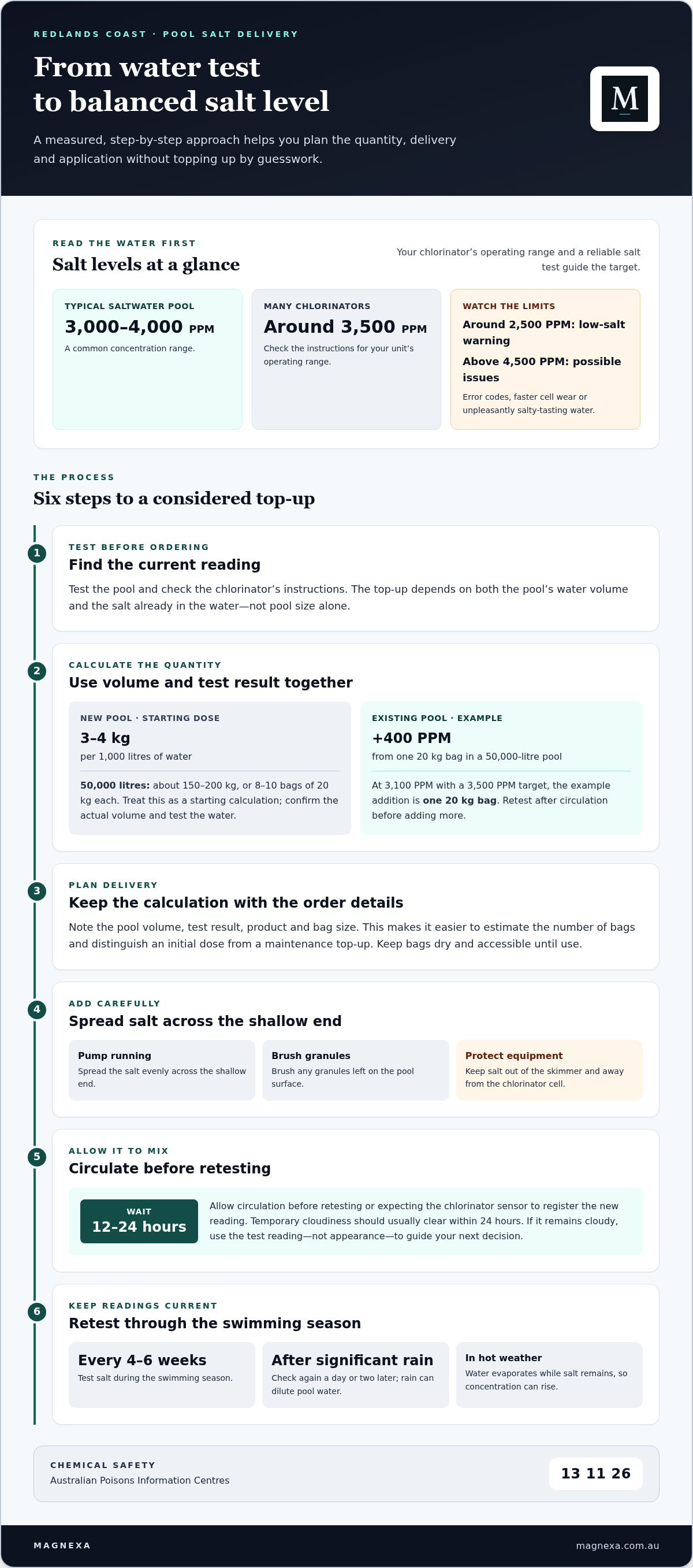
For Redlands Coast pool salt delivery, work out the pool’s salt requirement from its water volume and current test result. A typical saltwater pool concentration is 3,000 to 4,000 PPM, and many chlorinators are designed to run around 3,500 PPM. The correct level depends on the chlorinator’s operating range, so use its instructions alongside a reliable salt test.
For a new pool, the general starting dose is 3-4 kg of salt per 1,000 litres of water. A 50,000-litre pool would therefore need about 150-200 kg initially, equivalent to 8-10 bags of 20 kg each. Treat that as a starting calculation, not a substitute for testing. The pool’s actual volume and the salt already present affect the top-up.
For an existing pool, calculate the difference between the measured reading and the target. As an example, in a 50,000-litre pool, one 20 kg bag raises the salt level by about 400 PPM. If that pool tests at 3,100 PPM and the desired level is 3,500 PPM, one bag is the suggested addition. Retest after circulation rather than adding more immediately.
Salt concentration affects both chlorinator operation and water feel. A low-salt warning usually appears around 2,500 PPM. Above 4,500 PPM, a chlorinator may show error codes, its cell may wear faster, and the water may taste unpleasantly salty. Saltwater pool water is about one-tenth as saline as ocean water, but an excessive pool reading can still affect comfort and equipment.
Plan delivery around the quantity your calculation indicates. Check your pool volume, test the water and note the product and bag size before reserving an order. This helps you estimate the number of bags instead of guessing. Keep bags dry and accessible until use. For a newly filled pool, confirm its water volume before calculating the initial dose.
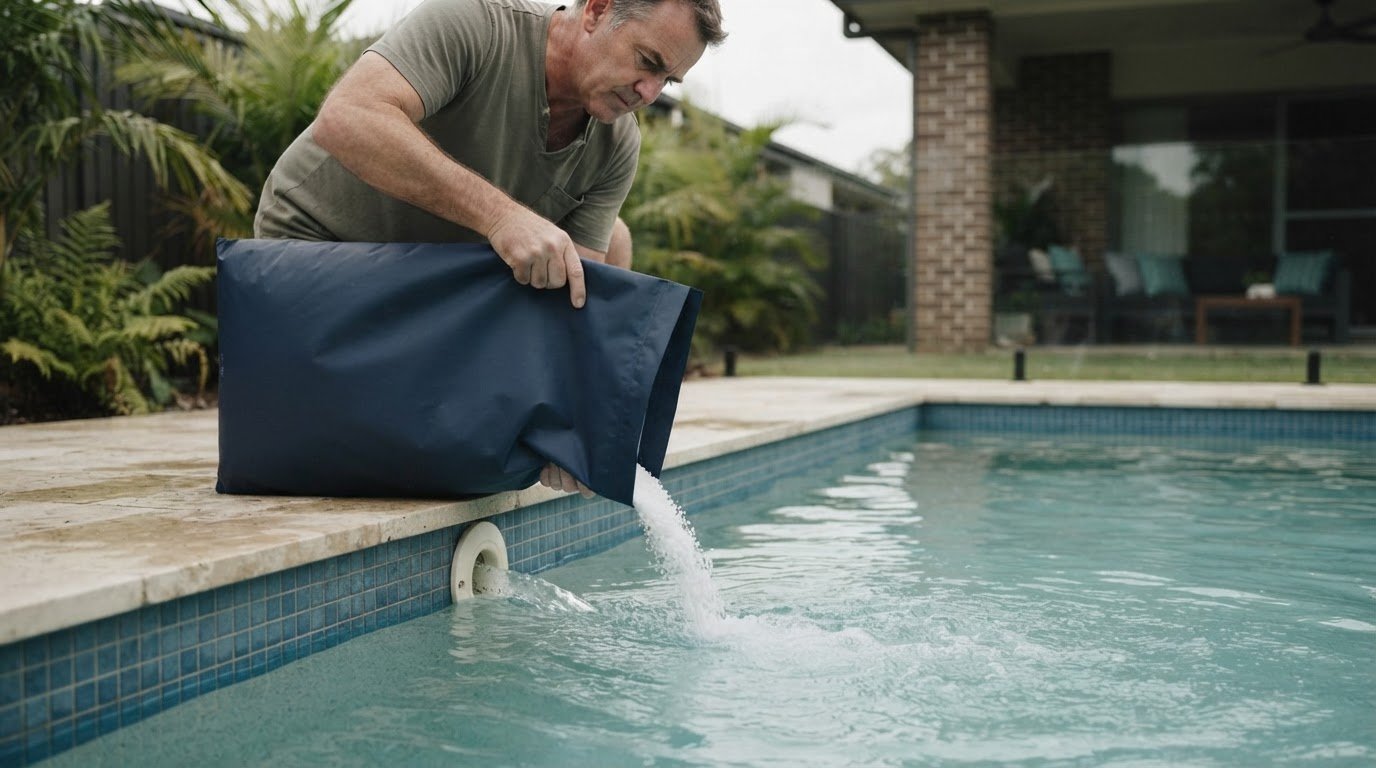
When adding salt, spread it evenly across the shallow end while the pump runs. Brush any granules left on the surface and keep salt out of the skimmer and away from the chlorinator cell. Salt placed directly in those areas can damage equipment. Allow 12-24 hours for circulation before retesting or expecting the chlorinator sensor to register the new reading.
Temporary cloudiness after adding salt should usually clear within 24 hours. If it remains cloudy, avoid adding more salt based only on appearance; the test reading is the useful measure. Test salt every 4-6 weeks during the swimming season, and check again a day or two after significant rainfall. Rain can dilute pool water. In hot weather, water evaporates while salt remains, so concentration can rise.
For delivery planning, keep the calculated quantity and test result together. That makes it easier to distinguish a full initial dose from a smaller maintenance top-up. Recheck after heavy rain, rather than assuming the previous reading still applies. For chemical safety, Australian Poisons Information Centres lists 13 11 26 as the contact number in Australia.
Magnexa: magnesium pool salt
Magnexa supplies magnesium pool minerals for pool owners in the Redlands Coast and across South-East Queensland, including Brisbane, Moreton Bay, the Sunshine Coast, Ipswich, Logan and Redlands, and the Gold Coast. The minerals work alongside a reduced chlorine level for softer-feeling pool water without the chlorine smell. Use Magnexa’s dosing calculator to estimate the quantity needed for your pool.
Pool minerals are available in 10 kg and 25 kg bags. The smaller bag can suit a modest top-up; the larger bag may be more practical when a pool needs more product. Base the amount on your pool’s water volume and its current mineral reading, rather than bag size alone. Magnexa’s Healthy pool salts offer a further option within its pool salt range.
For a magnesium mineral option for your pool, contact Magnexa to discuss the product that suits your needs.
Choose the right next step for your pool
For Redlands Coast pool salt delivery, make the next decision around the water you want in your pool, not simply the size of the order. If you’re considering a magnesium option, keep your pool’s current treatment and mineral requirements in view. That gives you a clearer basis for choosing a product and planning its use.
Magnexa offers magnesium pool salt, Pool minerals 10kg and Pool minerals 25kg. These options provide a practical starting point for comparing bag sizes and mineral treatments for your pool. Choose the direction that fits your pool-care plans, then take the next step with the product information in mind.
For help with your pool salt choice, contact Magnexa about pool salt. A considered choice makes the next stage of pool care easier to plan.
More articles